
OCTOBER, 2026
Book at a glance
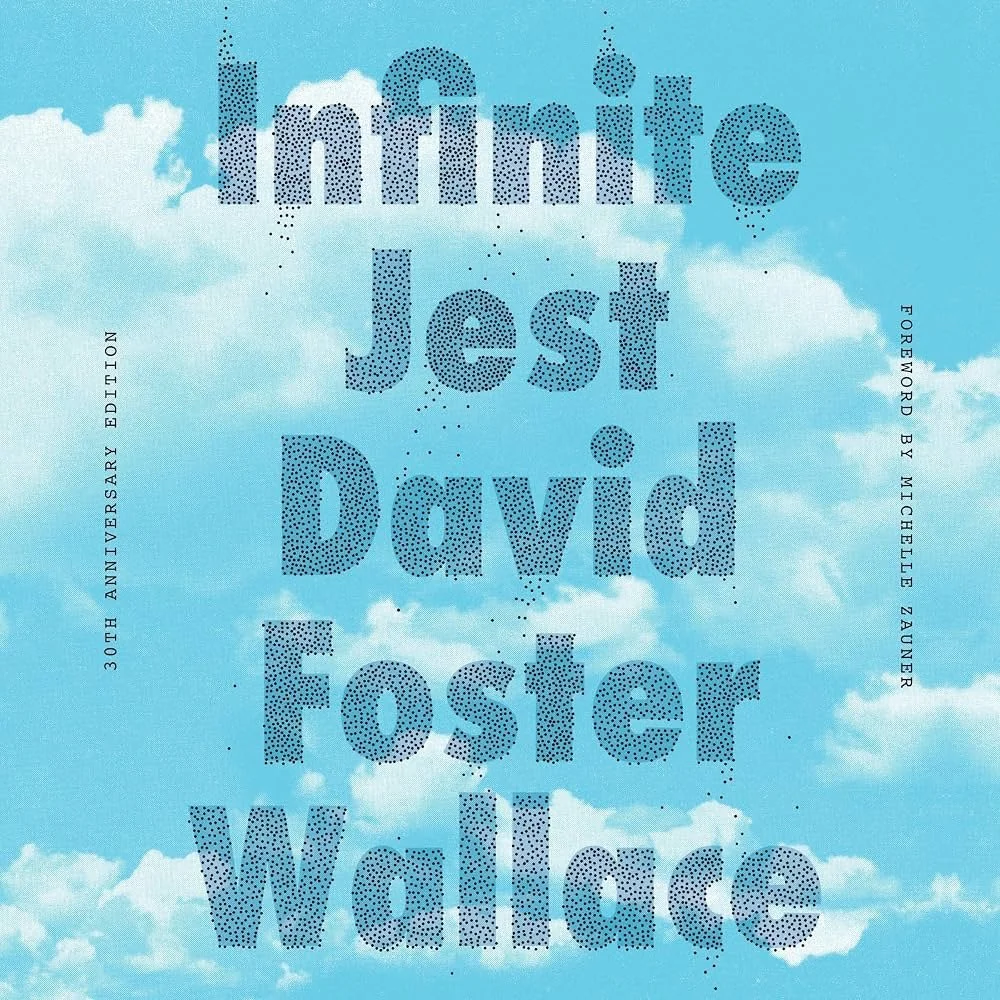
Author: David Foster Wallace
First published: 1996
Genre: Literary Fiction / Postmodern Fiction
My copy: Abacus, Paperback, 2006/2007
I first came across Infinite Jest in the way one often comes across books of this kind: through its reputation. I knew it was enormous, knew about the endnotes, knew that people abandoned it, and knew that finishing it had somehow become an achievement in itself. None of this made me particularly keen to read it. In fact, there is something faintly irritating about a book arriving with instructions about how formidable it is supposed to be. But I eventually started it, and for quite a while the reputation seemed entirely justified. It is a difficult book, and I don't mean difficult in the slightly flattering sense in which we sometimes describe books we think we ought to admire. It is genuinely hard work in places. It is more than a thousand pages long, with nearly a hundred pages of endnotes, some of which have their own footnotes. The chronology jumps around. People appear without much explanation. Wallace uses abbreviations long before you know what they stand for. He can spend pages on tennis drills, pharmaceuticals, recovery meetings, video cartridges and the mechanics of things I wasn't always convinced I needed to know about. There were occasions when I reached the bottom of a page and realised that although I had technically read every sentence, very little of it had actually entered my head, so I went back and read it again. Quite often.
The strange thing is that after a while this stopped bothering me. I stopped expecting the book to meet me halfway and began reading it on its own rather unreasonable terms. I don't know exactly when that happened, and there was certainly no moment of revelation when all the pieces suddenly fell into place. Plenty of them never did. But somewhere in those thousand-odd pages I stopped thinking about how difficult Infinite Jest was and started thinking about the people in it. Published in 1996, the novel is set in a version of America just far enough into the future to be recognisable and ridiculous at the same time. Years have corporate sponsors. The United States, Canada and Mexico have been rearranged politically. There is an environmental catastrophe involving an enormous amount of rubbish. There are Quebec separatists in wheelchairs. There are terrorists, academics, addicts, tennis prodigies and a family called the Incandenzas who are damaged in enough different ways to keep a considerably shorter novel occupied.
Much of the book moves between two places. The Enfield Tennis Academy is full of gifted young players being trained to become even more gifted. Nearby is Ennet House, where recovering addicts are trying to get through another day without drinking or using drugs. At first the two worlds seem very different. One is about discipline and achievement, the other about people whose lives have fallen apart. Gradually they begin to look much more alike, because almost everyone in both places is trying to get somewhere else. The tennis players want to become better than they are. The addicts want not to be the people they have become. Parents want things from children and children want things from parents. People want success, drugs, alcohol, sex, approval, distraction, love. Sometimes they simply want whatever is happening inside their heads to stop for a while. Wallace is very good on that particular human desire, and also on how easily something that gives relief can become something one can no longer live without.
Then there is the Entertainment, a film made by James Incandenza, filmmaker, founder of the tennis academy and father of Hal. It is supposedly so entertaining that anyone who sees it wants nothing except to see it again. They stop eating, stop talking and stop caring about anything outside the screen; given enough time, they will die watching it. Reading this in 2026 makes the obvious comparison almost impossible to avoid. Wallace wrote the novel before smartphones, social media, streaming platforms and algorithms became part of ordinary life. We now carry devices containing more entertainment than anyone could consume in several lifetimes, and those devices have become rather good at learning what will keep us looking at them. It would be easy to say Wallace predicted all this, but I'm not sure he did, and I'm not sure it matters. What he understood was much older than the technology: our desire to be distracted from ourselves.
That part interested me enormously, perhaps because I have spent most of my adult life telling stories. Filmmakers are always talking about holding an audience. We worry about pace, whether a scene is too long, whether somebody will become bored and look away. When we succeed, we call it engagement. Wallace takes that perfectly respectable ambition and pushes it to a rather horrifying conclusion: what if you made something from which the audience simply couldn't look away? There is something uncomfortable about that question when you have spent years trying to do precisely the opposite of losing an audience, and it made the Entertainment much more interesting to me than simply treating it as a remarkably prescient joke about television, streaming or the internet.
What surprised me more was how sad the book is. That isn't what I had expected from everything I had heard about it. I expected cleverness, and there is an exhausting amount of cleverness. Wallace can be very funny and very showy, sometimes on the same page. There were moments when I wanted to tell him that I already understood he was extraordinarily intelligent and that we could perhaps now continue with the story. But beneath all that is an extraordinary amount of loneliness. Hal Incandenza is intelligent, articulate and talented, yet increasingly unable to make himself understood. Don Gately, a recovering addict with a violent past, became the character I cared about most. His world is much less intellectually dazzling than Hal's. He is trying to stay sober, and sometimes that means doing things he thinks are ridiculous because somebody who has stayed sober longer than he has tells him they work. At Ennet House, people repeat clichés that Wallace knows perfectly well are clichés. The interesting thing is that the clichés occasionally help and intelligence occasionally doesn't.
That reversal is one of the things I liked most about the novel. We tend to assume that understanding something gives us power over it, whereas Infinite Jest repeatedly suggests otherwise. You can understand perfectly well why you are unhappy and remain unhappy. You can understand addiction and still be an addict. You can be exceptionally intelligent and have no idea how to live. Conversely, you can say something embarrassingly simple to somebody in pain and occasionally it is exactly what they need to hear. For a book famous for being complicated, some of its best observations are surprisingly uncomplicated, and I found myself remembering those moments more readily than many of the elaborate constructions for which the novel is famous.
I also began to wonder whether the difficulty of reading it was connected to what Wallace was writing about. I don't want to push that argument too far because it can become a convenient way of excusing almost anything a difficult novel does. Sometimes a long passage is simply a long passage, and there were certainly places where I wished an editor had been standing behind Wallace with a slightly larger red pencil. But Infinite Jest doesn't allow much passive reading. It interrupts itself, makes you turn to the endnotes and then find your way back, introduces somebody and expects you to remember them hundreds of pages later, withholds explanations and gives you explanations for things you hadn't particularly wanted explained. You have to participate in reading it, which seems rather appropriate for a novel containing a film whose audience doesn't have to participate at all.
I didn't love every part of the book, and I don't know that I completely understood every part of it. There were sections I admired rather than enjoyed, others I endured, and a few where I wondered what would actually be lost if twenty pages quietly disappeared. I don't subscribe to the idea that difficulty itself is a virtue. A book isn't profound simply because it makes the reader work hard, any more than a film becomes serious because it is three and a half hours long. But I am glad I read it, and what is odd is that I can't quite say I have finished with it. Most novels become smaller once you've read them. You know what happened, you know who mattered, you remember certain scenes and forget others, and eventually the book settles into a reasonably manageable place in your head. Infinite Jest hasn't done that for me. Parts of it remain unresolved, some deliberately and some perhaps because I missed things. I suspect that if I opened it again I would find connections I didn't notice the first time, although the prospect of immediately beginning another thousand pages is not one I am going to pretend fills me with joy.
I finished the book some time ago, and what I find myself remembering most is how lonely it is. For all its scale, its cleverness and its exhausting abundance, Infinite Jest is full of people trying to get away from themselves, sometimes through ambition, sometimes through addiction, sometimes simply through distraction. Every so often, someone manages to make another person stay where they are for a little longer. Those are the moments that have stayed with me. For all Wallace's intelligence, all the structural games and all those pages that made me wonder whether I had entirely lost the thread, that is the part of Infinite Jest that seems to me the most worth carrying away.
SEPTEMBER, 2026
Book at a glance
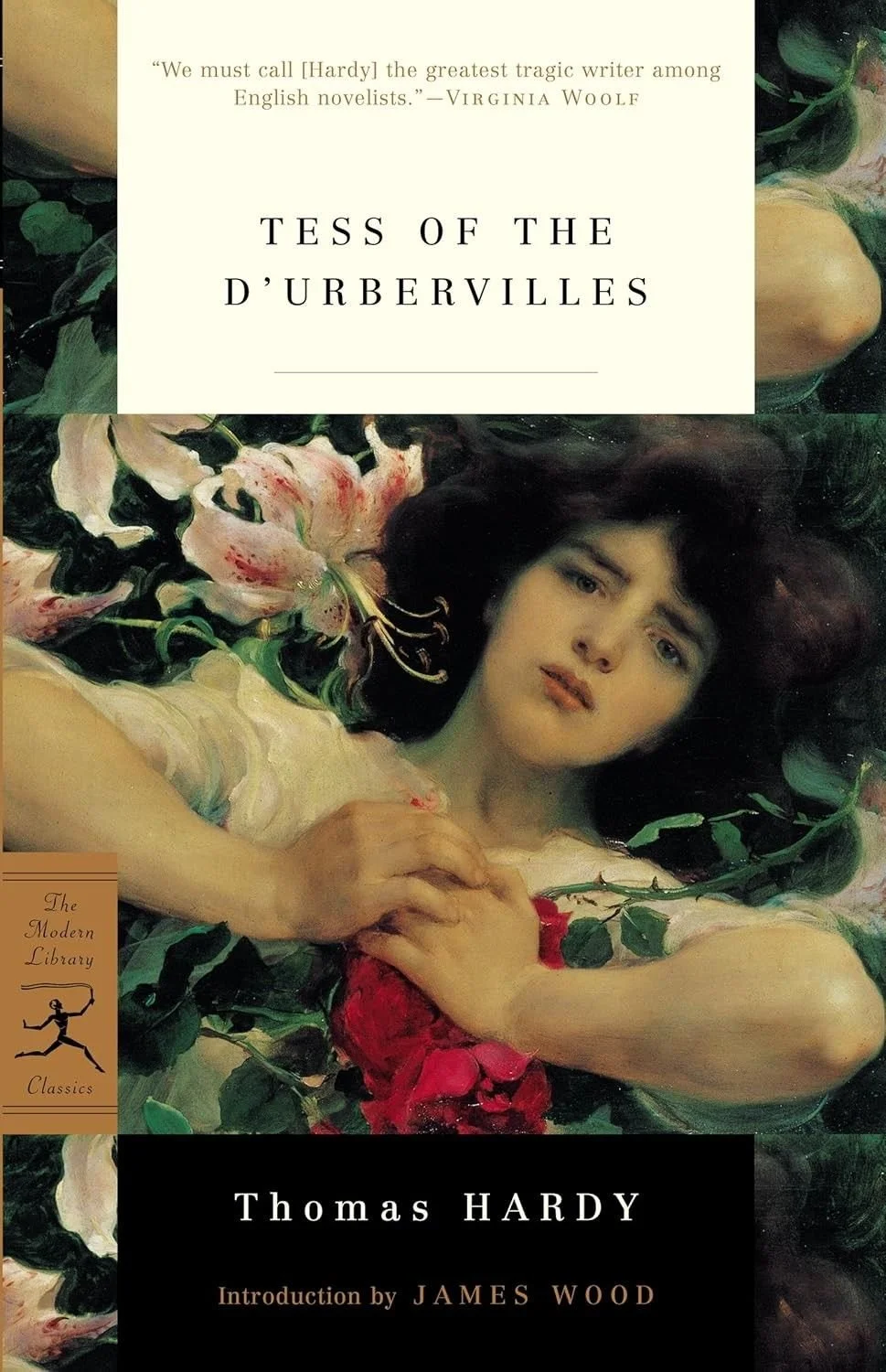
Author: Thomas Hardy
First published: 1891
Genre: Victorian Realism
My copy: Penguin Classics
I read Tess of the d'Urbervilles the way most of us first read anything at school: because it was on the syllabus, because an exam was waiting at the end of it, and because a teacher had decided, on our behalf, that this particular Victorian novel about a dairymaid's ruin was the one we needed. I remember being fifteen, or thereabouts, and finding the book slow in the places a fifteen-year-old finds everything slow, the long descriptions of the Wessex countryside, the dialect passages I skimmed rather than read, the sense that Thomas Hardy was in no hurry to get anywhere. What I did not skim, what stayed with me even as the syllabus itself has long since dissolved into a blur of dates and set essays, was the injustice at the centre of it. I did not have the vocabulary at fifteen to call it that. I only knew that something in the book felt wrong in a way that had nothing to do with plot, and everything to do with how the world had been arranged to receive one particular kind of person.
For anyone who has not read it, or who read it decades ago and remembers only the broad shape: Tess Durbeyfield is a poor countrywoman whose family, informed that they descend from Norman nobility, send her to claim kinship with a wealthy family who share their name. There she is pursued, and eventually raped, by Alec d'Urberville, a man with no real claim to the name at all, merely money enough to have purchased it. She bears his child, who dies in infancy. Years later she falls in love with Angel Clare, an idealistic young man who marries her, and who abandons her on their wedding night the moment she confesses what happened with Alec, and does so precisely because he believes every word of it. Angel, who has his own past indiscretion to confess and does so with far less anguish than he demands of her, cannot forgive in Tess what he has already forgiven in himself. The novel ends, as anyone who has read it will remember, at Stonehenge, with Tess arrested for a murder the book has spent four hundred pages making entirely understandable, and Hardy's own bitter closing line about the "President of the Immortals" having ended his sport with her.
What strikes me now, reading it again as an adult who has spent a career telling stories, is how precisely Hardy identifies the actual crime of the book, and how carefully he distinguishes it from the crime everyone in the story believes has been committed. Tess is punished, repeatedly, by nearly every institution and person she encounters, for something that was done to her rather than something she did. Her family exploits her. Alec violates her. Angel condemns her for the violation rather than the violator. The law finally executes her for the one act in the entire novel in which she has genuine agency, and even that act is presented as the inevitable consequence of everything that preceded it. Hardy does not ask his reader to decide whether Tess is guilty. He asks his reader to notice that guilt, in the world the novel describes, has almost nothing to do with what a person actually does, and almost everything to do with what a person is permitted to have happen to them without being blamed for it.
I did not have language for this at fifteen. I have spent a good part of my working life since then, across novels, and across the several films I have made, drawn back to some version of the same question, usually without setting out to be. A story about a dancer whose talent is inseparable from a body that other people insist on having opinions about. A story about a woman whose desire is treated, by everyone around her, as a problem to be managed rather than a fact to be respected. I do not think this is coincidence, and I do not think it is unique to me. Hardy identified something that has never stopped being true, which is that societies are extremely good at deciding, after the fact, that a woman's suffering was somehow her doing, and extraordinarily reluctant to extend the same forensic curiosity to the men involved. Angel Clare is not a villain in the way Alec is a villain. He is something worse, in a way, because he is entirely sincere. He genuinely believes his own logic. That is what makes him unbearable to read, and it is also, I suspect, why Hardy gave him more page space than he gave Alec. Villainy is easy to write and easier to dismiss. Sincere, well-intentioned cruelty is the harder and more useful subject, because it does not go away once the villain is punished. It simply puts on a clean collar and marries someone else.
I do not think Tess is a perfect novel. Hardy's own narration occasionally editorialises in ways that feel heavy-handed now, and his fondness for coincidence, for letters that arrive under the wrong door at the wrong moment, asks a fair amount of patience from a modern reader. But the central architecture of the book, the distance between what a person has done and what a person is blamed for, has not dated at all. If anything it has become easier to see clearly, because I no longer need Hardy to explain it to me in the abstract. I have watched it operate, in smaller and larger ways, in rooms I have actually stood in.
What I return to, more than the plot or even the injustice, is the dairy at Talbothays, the one genuinely happy stretch of the novel, where Tess and Angel fall in love amid the actual, unglamorous work of milking cows and making butter, and where Hardy, usually so intent on punishing his heroine, allows her a summer of something close to peace before he takes it away again. The tragedy itself is well signposted from the title page onward, so it is the part that has stayed with me the least. What has stayed with me is the fact that Hardy bothered to let her have the summer at all. He did not need to. A crueller novel, or a lazier one, would have rushed her straight from ruin to ruin. Hardy gives her Talbothays anyway, weeks of real, undeserved happiness, before the machinery of the plot closes back around her, and I have come to think that this is the more honest and the more devastating choice, because it insists that the joy was real even though it did not last, and that a life is not simply the sum of how it ends.