
THE CREATIVITY SERIES
Living With Uncertainty
An essay on the hidden interval between finishing creative work and its reception, and why uncertainty is an essential companion to every artistic life.
There is a stage in every creative life that gets remarkably little attention. We talk enthusiastically about inspiration, and with equal enthusiasm about success. The stories we tell ourselves tend to move briskly from the first idea to publication, from the completed film to its premiere, from the finished manuscript to the reader holding it in their hands. Reality, with its usual disregard for tidy narratives, inserts a substantial interval between those two points, one measured not in days or weeks but often in months, sometimes years. This is the season of waiting.
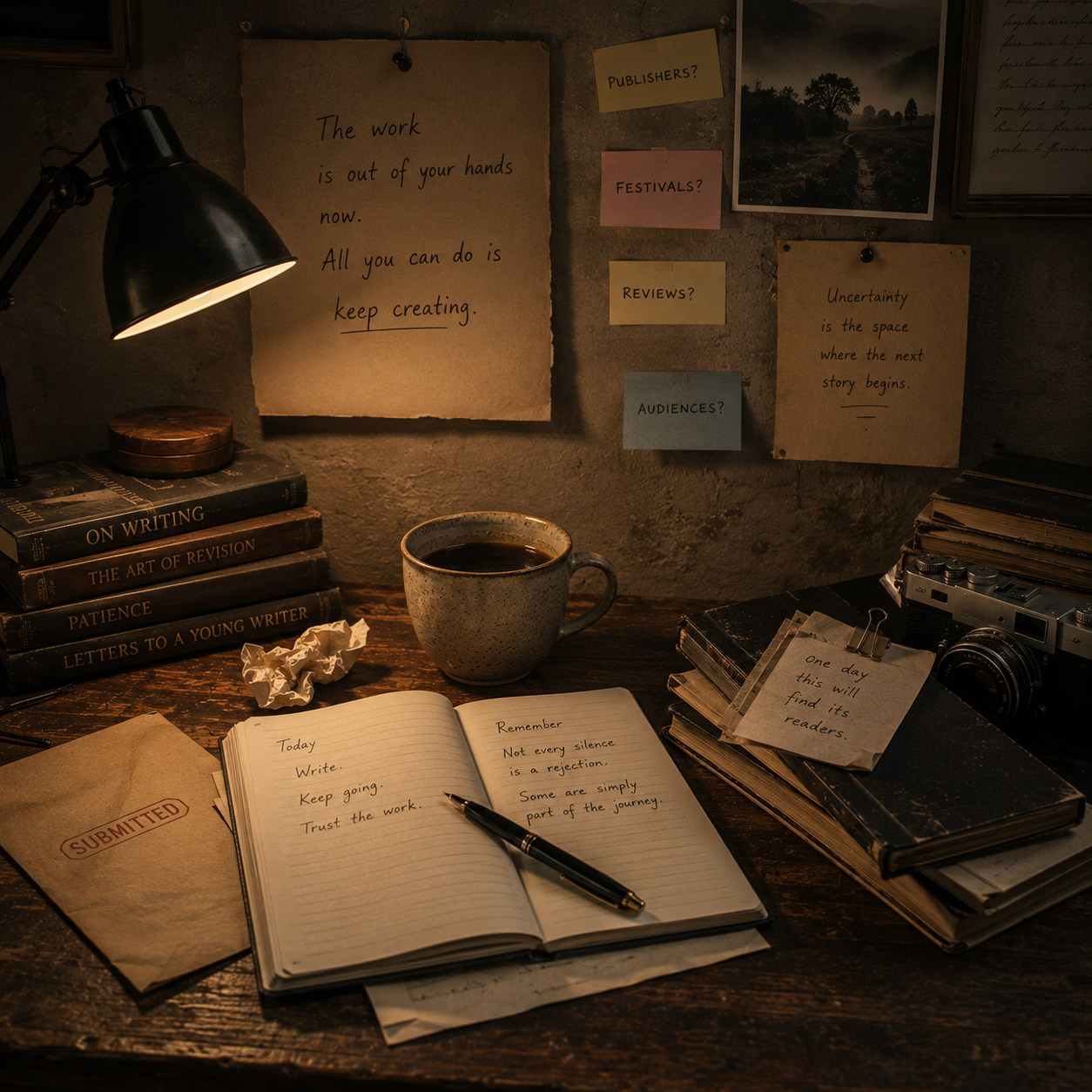
Waiting has an unfortunate reputation. It suggests inactivity, as though life has politely agreed to pause until someone else reaches a decision. In practice it is rarely passive, and it has a rhythm of its own that runs alongside ordinary life without ever quite leaving it. A manuscript has gone out to publishers. A film has been sent to festivals. Review copies have made their way into the world. Somewhere out of sight, conversations are happening in rooms one will never enter, among people one may never meet, about work that has taken up years of one's life. Nothing seems to be happening. Nearly everything that matters is happening somewhere else.
That distance between creator and work can be unsettling in ways one does not expect. During the years of making something, every problem has an answer, however hard to find. A chapter can be rewritten. A scene can be reshot. Dialogue can be trimmed, music reconsidered, an ending nudged toward greater honesty. The work stays responsive to effort. Waiting is a different condition entirely. The manuscript has already become itself. The film has already found its final frame. No amount of further labour will improve it now. All that is left is to wait while other people meet it in their own time, and creative people, as a rule, are not naturally suited to that.
Making something feeds the comforting illusion that effort and outcome live next door to each other: work harder, think longer, revise once more, and the project improves. Waiting quietly dismantles that illusion. Once the work leaves the studio or the writing desk, effort and outcome drift surprisingly far apart. The quality of the work still matters enormously. Beyond that, though, an unreasonable number of variables start shaping its journey — timing, circumstance, changing taste, the interests of strangers, chance conversations, crowded schedules, plain luck — all of them joining the story without asking permission. This tends to be mildly maddening for anyone with a taste for order.
There is also imagination's habit of filling every silence with speculation. Days pass without an email. Weeks pass without a call. The mind, with striking efficiency, immediately starts building explanations for both. The publisher must have disliked the manuscript. The festival committee has surely forgotten the film exists. The reviewer has decided that reading anything else would be a better use of the afternoon. None of these conclusions rests on the slightest evidence. They arise because uncertainty has always been fertile ground for invention.
One learns, slowly, that silence rarely means what an anxious imagination insists it means. Rainer Maria Rilke told young artists to live patiently with unanswered questions rather than demand certainty from them right away. The advice fits the long intervals that follow completion just as well as it fits the making itself. Creative work often asks for the same patience after it leaves us as it did while it was still being built.
Publishing houses go on reading manuscripts between meetings, contract negotiations, and correspondence with dozens of other authors, at a pace considerably less dramatic than any hopeful writer would prefer. Film festivals receive hundreds, sometimes thousands, of submissions, each one watched, argued over, and weighed by people trying to make careful decisions inside impossible deadlines. Reviewers sit under stacks of books tall enough to worry a structural engineer. None of this makes the waiting easier to feel, though it does occasionally restore some perspective.
Perspective turns out to be one of the more useful companions during these stretches. Every creator eventually learns that a completed work's future is only partly within their control. That can feel discouraging at first and often becomes freeing later. Once the work has honestly become the best version one knows how to make, there is very little to gain from rehearsing conversations that have not happened yet. The story has left home. It deserves the chance to find its own way, though understanding that is a good deal easier than actually living it.
The temptation to measure progress by external response is almost impossible to resist. We count acceptances, reviews, invitations, sales, screenings, rankings, because they look wonderfully objective — numbers, dates, reassuring certainty. The quieter achievements resist counting. Becoming a better writer in the years between books. Learning patience while nothing visible seems to be happening. Noticing that the next idea has already started arriving while the last one is still finding its way through the world. These developments rarely make it into a biography, and they may be the ones that matter most.
I have grown suspicious, over time, of the idea that a creative life unfolds as a neat sequence of milestones. There is no point at which uncertainty politely leaves and confidence moves in for good. One book leads to another period of waiting. One film ends and another begins its own uncertain journey. Success changes the scale of the expectations more than it removes the uncertainty itself. Every meaningful project eventually reaches the same threshold, where its creator can do nothing more than release it into the care of people whose responses belong entirely to them.
The challenge, then, is not eliminating uncertainty. It is learning to live beside it without letting it write the story of one's days. There is a real difference between waiting and postponing a life. Waiting accepts that some outcomes cannot be rushed. Postponement hands the authority over one's days to events that have not happened yet. Creative work teaches the opposite lesson. The manuscript may be sitting on an editor's desk, the film waiting on a festival programmer, the review not yet written, but the creator's own life still has to move. Curiosity cannot be put on hold until certainty finally shows up.
The longer one stays in creative work, the clearer it becomes that uncertainty is not an unfortunate interruption to the process. It is the process. Every book, film, and piece of music eventually enters a stretch where its future belongs mostly to other people. A manuscript lands on an editor's desk. A festival programmer presses play. A reviewer opens the first page. Somewhere, months later perhaps, a stranger wanders into a bookshop or pauses before clicking on a film they had never heard of an hour earlier. None of these moments can be scheduled. The work simply starts travelling through lives its creator will never reach.
That requires a real shift in perspective. While making something, one gets used to solving problems through effort. A weak chapter can be rewritten. A scene lacking emotional clarity can find another approach. Progress depends mostly on persistence. Waiting offers none of that satisfaction. It asks for a discipline that feels almost contradictory: doing nothing to the completed work while doing everything possible for the next one. That distinction took me a good deal longer to understand than I like to admit.
It is remarkably easy to start living in anticipation of a reply. One refreshes an inbox with the optimism of someone convinced fate has simply misfiled an email by a few hours. Every unfamiliar phone number takes on improbable weight. Conversations get interrupted by the faint suspicion that today might finally be the day everything changes. The trouble with organising a life around expected news is that most days provide none of it. The work sits exactly where it did yesterday, and the creator has quietly handed over another perfectly good afternoon to speculation.
Uncertainty, left unchecked, has a real appetite. Given enough attention it expands to fill every corner of the day, reading ordinary delay as meaningful, ordinary silence as a verdict, ordinary coincidence as evidence. Creative people, blessed with active imaginations, are unusually good at writing elaborate stories whose only real function is manufacturing extra anxiety. It is one of the rare moments when imagination proves considerably less useful than plain reality.
Reality, by contrast, tends to be mundane. Editors run late because they are reading six other manuscripts alongside yours. Festival committees argue because several people love entirely different films. Reviewers get sick, travel unexpectedly, or simply need more time than anyone expected. Booksellers wait on deliveries. Streaming platforms shuffle release dates. Life keeps moving to its own practical logic, largely indifferent to the elaborate stories impatient creators build around it. Most silences turn out to have administrative rather than existential explanations, and there is something oddly comforting in that. It frees attention to go back to the one place it has ever actually been useful: the work itself.
The healthiest stretches of waiting, in my experience, are the ones where another idea starts quietly demanding attention. This is not a distraction technique. It reflects the fact that creativity has always preferred motion to fixation. The finished work keeps travelling through the world while another, still invisible, starts taking shape in the imagination. Slowly the emotional centre of gravity shifts. Yesterday's manuscript becomes tomorrow's published book. Today's unwritten story becomes the place where curiosity now lives.
There is a danger, though, in letting every new project become nothing more than an antidote to uncertainty. Creation deserves better than that. Nobody writes a book purely to stop thinking about the last one. Films get made because certain stories keep insisting on being told, regardless of how they are eventually received. If external response becomes the main reason for making anything, uncertainty gets handed far more power than it has earned. The work has to stay the centre. Everything else orbits around it.
This is why the creators I admire most seem quietly detached from immediate outcomes, though that should not be mistaken for indifference. They care a great deal about readers, audiences, and criticism offered in good faith. They have simply learned that none of it can serve as the measure of whether the work was worth making. Every meaningful creative life holds projects that succeed beyond expectation alongside others that travel much more quietly through the world. Both keep teaching. Both become part of the long conversation the next piece of work grows out of.
There is another gift buried in uncertainty, though it only shows itself with some acquaintance. It teaches humility. Our work enters lives we can neither predict nor control. Readers find meanings never consciously intended. Viewers bring their own histories, losses, hopes, and questions to a film. A story stops belonging entirely to the person who made it and begins belonging, in small ways, to whoever encounters it. Uncertainty is the price paid for that kind of freedom, and it is not a bad trade.
Waiting also carries an unexpected question inside it: whether a person's sense of self rests on what has already been finished, or on the ongoing desire to keep making things. If the answer depends entirely on publication, awards, festivals, or reviews, every stretch of silence feels like a personal loss. If the deeper satisfaction lives in the act of making itself, uncertainty gradually loses most of its authority. It stays present, certainly. It simply stops occupying the biggest room in the house.
That is the lesson a creative life eventually offers, one way or another. Certainty is rare. There will always be another manuscript waiting on a decision, another film travelling toward an audience, another review not yet written, another project whose future is still out of view. The waiting never fully disappears. What changes is a person's relationship to it. One learns to greet uncertainty almost like an old acquaintance, occasionally exasperating, rarely predictable, but no longer able to stop the next sentence from getting written.
In the end, the most important work has always happened long before any reply arrives. It happened during the solitary mornings, the rewritten chapters, the abandoned scenes, the conversations with characters who existed nowhere but the imagination. Everything after that, however satisfying, belongs to a different stage of the journey. I still refresh my inbox some mornings out of habit rather than hope, and most mornings it has nothing to tell me. That used to feel like a small failure. Now it mostly just feels like a Tuesday, and I have learned to be glad of those, because a Tuesday with nothing in the inbox is a Tuesday with nothing standing between me and the next page.
AK Srikanth is an Indian novelist, filmmaker and essayist whose work explores storytelling across literature, cinema and performance. He is the author of A Song for Eresha and writes from the Nilgiris in southern India.
Related Essays