
THE STORIES SERIES
Why the greatest works of literature reveal new meanings at every stage of life, and why rereading is one of the deepest pleasures of reading.
The Books We Grow Into
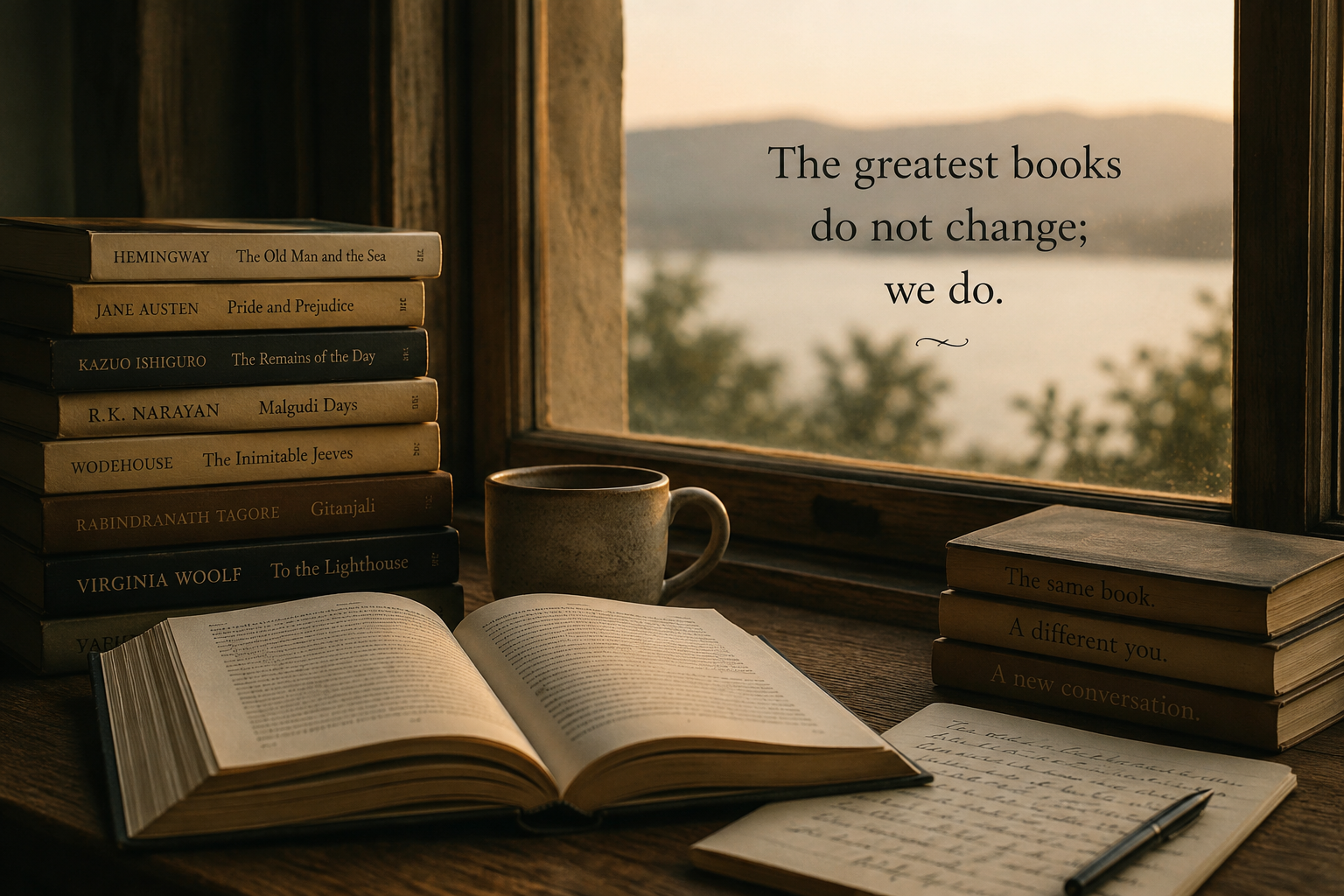
There is a comforting belief, usually formed in youth and abandoned only with real reluctance, that books remain exactly as we left them. They wait upon a shelf, gathering little more than dust and the occasional disapproving glance from someone wondering why we continue buying new ones when several hundred unread volumes are already available. Their words do not alter. Their endings remain stubbornly faithful to themselves. The fisherman still sails into the Gulf Stream. Elizabeth Bennet continues to misjudge Mr Darcy with admirable confidence. Jeeves rescues Bertie Wooster from yet another entirely avoidable social catastrophe. We imagine that, because the pages have remained unchanged, our experience of them will do the same. It is one of literature's smaller pleasures that this assumption turns out to be gloriously mistaken.
Every serious reader eventually discovers the unsettling sensation of opening a familiar book and finding an unfamiliar companion. The novel remembered from twenty years earlier appears to have developed opinions of its own. Entire passages seem to have appeared from nowhere, while scenes once regarded as profound have acquired a faintly theatrical quality. We blame ourselves at first, assuming we have forgotten large sections of the text. The truth is more interesting than that. The book has not changed. The reader has. Somewhere between one reading and the next, life has rewritten the person holding it.
The first time we encounter a great novel, we often arrive with astonishing confidence. Youth possesses many admirable qualities, but modesty rarely ranks among them. At eighteen, one approaches The Old Man and the Sea believing it to be a story about determination. Santiago refuses defeat. He sails farther than anyone else. He struggles against forces larger than himself. The marlin becomes triumph. The sharks become adversity. The ending feels noble because youth has an instinctive affection for victory, even when victory arrives looking suspiciously like defeat. One closes the book persuaded that perseverance has carried the day, entirely overlooking the loneliness that runs through every page.
Read the same novel three decades later and an altogether different figure begins to emerge. Santiago no longer appears heroic simply because he continues fishing. He becomes remarkable because he continues believing that his labour retains meaning after years of disappointment. His conversations with the boy carry a tenderness that scarcely registered before. His solitude ceases to resemble adventure and begins to resemble companionship with oneself. Even the sea acquires another character. At eighteen it feels like a challenge waiting to be conquered. At fifty it resembles something far older, indifferent to human ambition and yet strangely generous to those prepared to accept its terms.
Much the same thing happens with George Eliot. Middlemarch is often admired by younger readers for the sheer richness of its world, yet it reveals its deepest sympathies only later. Dorothea's idealism gradually gives way to an appreciation of her generosity. Lydgate's ambitions become less a tale of personal failure than a study of how circumstance, compromise, and small disappointments shape ordinary lives. What once appeared to be a novel about remarkable people slowly becomes a novel about recognisably imperfect ones. Eliot understands, with uncommon tenderness, that maturity lies not in judging others more confidently, but in judging them rather less.
The transformation is not confined to Hemingway. Every enduring work of literature appears to contain several books concealed within a single binding. Which of those books reveals itself depends largely on who happens to be reading. I first encountered Kazuo Ishiguro's The Remains of the Day as a beautifully written novel about duty. Years later it became a meditation on regret. Reading it again, one notices something subtler still. Stevens is not merely sacrificing happiness. He is constructing a version of himself so disciplined that it eventually becomes impossible to distinguish performance from identity. One closes the novel with the uncomfortable suspicion that every profession asks us, to some degree, to perform precisely the same trick.
Rereading occupies an odd position in modern culture. We celebrate discovering new books, yet often overlook the equally rewarding experience of returning to familiar ones. Libraries preserve the past, while bookshelves preserve earlier versions of ourselves. A second reading is rarely an exercise in repetition. It is an encounter between an unchanged work and a changed reader. The text remains constant. Everything else has altered.
The books themselves seem almost amused by this arrangement. They reveal only as much as the reader is capable of recognising. It is rather like meeting an old friend after many years apart. The conversation appears to concern familiar subjects, yet both participants understand that they are really discussing the lives they have lived in the meantime. A sentence that passed unnoticed in youth suddenly acquires startling clarity because experience has supplied the missing context. Literature does not simply reward intelligence. It rewards living.
This may explain why recommendations are among the least reliable forms of literary guidance ever devised. We speak enthusiastically of books changing our lives while forgetting to mention the small but significant detail that they changed our lives under circumstances unlikely to be repeated with any precision. The novel that rescued one reader during bereavement may leave another entirely unmoved. The book that transformed someone's understanding of love may appear faintly sentimental to a reader who has not yet discovered what love has the alarming habit of demanding. Timing, it turns out, is one of literature's invisible collaborators.
There are books we admire immediately, books we struggle through with dutiful determination, and books that politely decline our acquaintance altogether. The temptation is to assume the fault lies with the book. Experience encourages a gentler conclusion. Some works simply arrive before their appointed hour. They stand upon a shelf for years, waiting with real patience while we acquire whatever life experience they require before opening themselves completely. I have returned to novels I once abandoned after fifty pages, only to wonder later how I had managed to overlook such beauty. The answer was almost certainly that the beauty had always been there. I had not.
Readers occasionally speak of "outgrowing" certain books, though I have never been entirely persuaded by the phrase. We may outgrow our enthusiasm for particular plots or styles, but the finest literature is remarkably resistant to becoming obsolete. If anything, it grows alongside us. What changes is the conversation. A novel read at twenty resembles an engaging lecture delivered by someone considerably wiser than ourselves. Read again at forty, it feels like a dialogue between equals. By sixty it may have become something closer to an old friendship, requiring very little conversation because both parties already understand what the other intends to say.
There is a real generosity in that relationship. Books never express disappointment that we failed to understand them earlier. They never remind us that an important passage was carelessly skipped in our youth or that we misunderstood an ending for almost two decades. They simply receive us as though no time has passed. Human beings might benefit from adopting a similar policy. We have a regrettable tendency to remember one another's earlier versions long after those versions have disappeared. Literature, by contrast, lets us begin again every time we open the cover.
I have gradually become suspicious of the question, "What is your favourite book?" It assumes that reading resembles collecting trophies rather than sustaining relationships. My favourite book at twenty bears little resemblance to the one I would choose today, and I rather hope the answer continues changing for as long as I continue reading. A fixed list of favourites would suggest that curiosity had retired from active service, leaving nostalgia to manage affairs in its place. Books deserve better than that, and so, I suspect, do readers.
If books possess a secret ambition, I suspect it is to persuade us that human beings are rather more complicated than they first appear. The finest novels rarely divide the world into admirable people and objectionable ones. They present individuals who drift uncertainly between generosity and selfishness, courage and hesitation, wisdom and spectacular misjudgement, often before breakfast. As younger readers we naturally search for heroes. Age encourages a quieter interest in those who simply continue despite their imperfections. There is something deeply reassuring about characters who do not become better people through dramatic revelation, but through small acts of persistence repeated over many years. Life, after all, has always preferred gradual revisions to miraculous transformations.
This changing perspective often reveals itself through the characters we notice. In childhood we identify instinctively with the young. Every story belongs to the child, the apprentice, the adventurer setting out into the unknown. The adults exist largely to create obstacles before eventually acknowledging the obvious brilliance of the protagonist. Reading the same books later produces an altogether stranger experience. One discovers oneself sympathising with parents, teachers, ageing neighbours, and elderly strangers who scarcely registered during earlier readings. The impatient father suddenly appears exhausted rather than unreasonable. The stern headmistress acquires a burden of responsibility invisible to younger eyes. Even the villain occasionally displays flashes of insecurity that were previously hidden beneath confidence. Literature has not changed sides. It has merely let us stand somewhere else.
I have always found this particularly moving when returning to books first encountered at school. At sixteen one reads because examinations demand it. Every chapter carries the faint aroma of impending assessment. Themes must be identified, symbolism carefully extracted, and essays produced demonstrating considerable certainty about matters that sensible adults generally admit remain open to interpretation. Years later the same books emerge from their academic imprisonment and breathe again. They cease to be subjects of study and recover their original purpose, which was simply to illuminate human lives. It is one of education's smaller ironies that some books begin revealing themselves only after we have finished being tested on them.
There are also books that accompany us through particular seasons of life with such fidelity that it becomes impossible to separate the reading from the period in which it happened. We remember the chair in which we sat, the room, the weather beyond the window, even the quality of light falling across the page. Open the novel years later and those forgotten surroundings return with real clarity. A paragraph becomes inseparable from an old apartment. A chapter recalls a railway journey. A single sentence summons an entire summer that had otherwise slipped almost unnoticed into memory. Books have a genuine gift for preserving not only themselves, but the readers we once were.
That may explain why second-hand bookshops carry a particular melancholy absent from most other shops. Every volume on those shelves once occupied a place of importance in somebody's life. It travelled beside a bed, sat patiently on a desk, survived several house moves, and perhaps accompanied its owner through moments of happiness and grief before finding its way into another pair of hands. One cannot help wondering what conversations those books have already witnessed. The annotations in the margin, the forgotten railway ticket pressed between two pages, the faded inscription inside the cover all suggest that every book leads a double existence. It contains the story the author intended, and another belonging entirely to the reader.
This partnership between writer and reader may be the most unusual relationship in the arts. A painter determines exactly what we see. A composer decides precisely what we hear. A novelist, by contrast, provides only language. Everything else is built inside the reader's imagination. Every drawing room, every mountain path, every expression crossing a character's face comes into existence through a collaboration between two minds that may never meet. It is an act of real trust. The writer offers words. The reader supplies memory, emotion, experience, and imagination. Between the two, a world appears.
As I have grown older, I have become increasingly grateful for books that ask questions rather than deliver conclusions. Certainty has always carried considerable commercial appeal, but very little resemblance to ordinary life. The novels that stay with us tend to resist tidy answers. They allow contradictions to coexist. They acknowledge that kindness and cruelty sometimes inhabit the same person, that love rarely arrives without misunderstanding, and that regret often accompanies even the happiest decisions. Such books have an uncommon respect for their readers. They trust us to complete the conversation ourselves.
This may be why rereading has gradually become one of my greatest pleasures. There was a time when I considered it vaguely irresponsible, almost an admission that I lacked sufficient curiosity to discover something new. A lifetime later the opposite seems true. Returning to a great novel resembles revisiting an old city. The principal landmarks remain reassuringly familiar, yet it is the smaller streets that reward attention. A café overlooked years earlier becomes the highlight of the visit. A side road reveals a view more memorable than the famous square everyone photographs. Familiarity does not diminish wonder. It refines it.
The shelves in our homes quietly record this evolution, though the books themselves are anything but quiet about it. Some remain untouched for years before unexpectedly demanding our attention. Others return so often that they begin resembling old friends who know precisely which chair to occupy without being asked. There are volumes bearing coffee stains from hurried breakfasts, pencilled notes written with misplaced confidence in our twenties, ticket stubs pressed between pages by readers who imagined they would remember why. We smile at those younger selves with a mixture of affection and embarrassment, yet there is something rather comforting in recognising that reading has accompanied every stage of becoming whoever we happen to be now.
That may be the real gift of literature. It offers continuity in lives that rarely feel continuous while we are living them. We are inclined to think of ourselves as entirely different people at twenty, forty, and sixty, yet the books that accompany us reveal an underlying conversation stretching across decades. The young reader searching for adventure, the middle-aged reader searching for meaning, and the older reader searching for perspective are not strangers to one another. They are successive chapters in the same story, meeting unexpectedly upon the same page.
For that reason I have never believed that the finest books are those we finish only once. Their greatest achievement lies elsewhere. They become companions to whom we return at different moments, discovering each time that they have been waiting with unfailing patience while we did the necessary growing. We congratulate ourselves on rediscovering them, although the truth is rather more humbling. The books knew exactly where they were all along. It was we who had taken the longer journey.
And that is perhaps why we never truly finish reading a great book. We merely pause the conversation until life has taught us enough to begin it again.
AK Srikanth is an Indian novelist, filmmaker and essayist whose work explores storytelling across literature, cinema and performance. He is the author of A Song for Eresha and writes from the Nilgiris in southern India.
If this resonated