
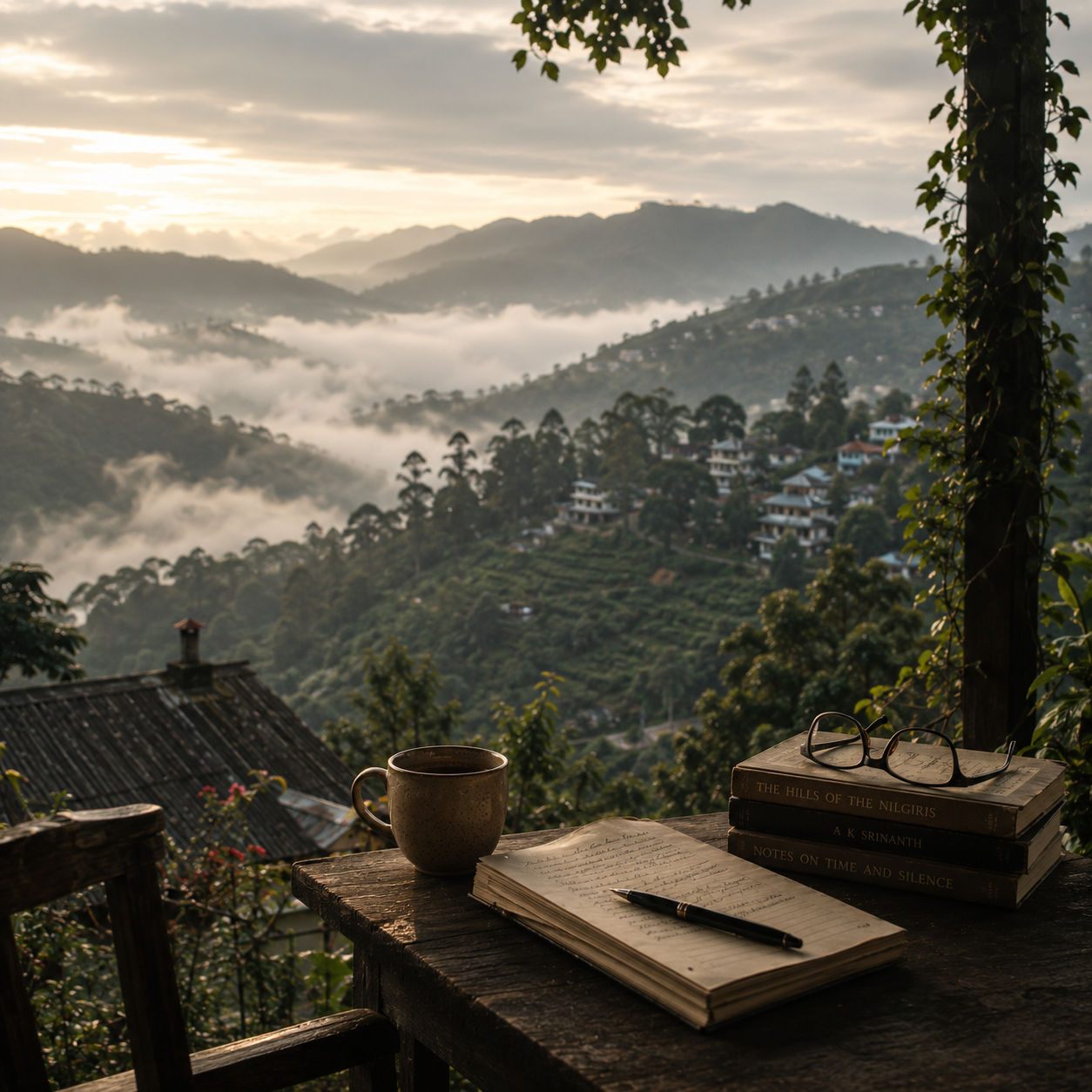
There are places that alter your address, and there are places that alter your relationship with time. The distinction is not immediately apparent. One arrives expecting a change of scenery and finds, rather unexpectedly, a change of rhythm. The Nilgiris did not persuade me to live differently through any dramatic revelation. There was no single morning when the mist lifted to reveal a superior philosophy of existence waiting among the eucalyptus trees. The change happened more gradually than that, through hundreds of ordinary days during which the hills went on living at exactly the same unhurried pace, while I slowly worked out that I was the only person in a hurry.
Having spent much of my adult life in cities, I had grown used to speed dressed up as efficiency. Days gained value according to how completely they could be filled. Meetings followed one another with admirable punctuality, emails piled up with the reliability of monsoon clouds, and every journey came wrapped in the comforting illusion that arriving five minutes earlier counted as real progress. There is, I suspect, an entire urban civilisation quietly devoted to saving small fragments of time, without ever pausing to ask what becomes of all those carefully hoarded minutes.
The hills met this philosophy with polite indifference. Nothing here seemed especially interested in acceleration. Mist arrived when it pleased. Rain rearranged afternoon plans without asking permission. A conversation at the local shop rarely stayed confined to the practical purpose that had brought one through the door in the first place. Deliveries reached their destination in due course, a phrase whose elasticity I gradually came to admire. Somewhere between the second week and the second month, I noticed an unexpected shift. The world around me had not slowed down. My own expectation that everything should happen at once had simply begun dissolving.
Weather played a real part in this education. Nan Shepherd wrote with real sensitivity about the way mountains change not just what we see but how we pay attention. Living in the Nilgiris suggested something similar to me, gradually. The landscape was not offering dramatic revelations. It was teaching a different way of noticing.
In a city, weather usually functions as a mild inconvenience. One carries an umbrella, postpones a walk, complains briefly, and carries on much as planned. In the Nilgiris, weather takes an active role in the day. Morning mist sets the mood of a landscape before a single word has been spoken. Rain changes the sound of an entire neighbourhood. Sunlight appearing unexpectedly after several overcast days has the small celebratory quality of an old friend turning up unannounced. One gradually stops resisting these changes and starts building life around them instead of against them.
That adjustment moved naturally into the work itself. I had assumed that moving to the hills would simply give me a more attractive backdrop for writing. Instead the work changed. The hours stayed roughly the same, but their quality felt entirely different. A sentence no longer had to compete with traffic, appointments, or the low background static of urban urgency. It found room to breathe. Ideas arrived less like commuters shoving through a railway platform and more like visitors who had made the effort to travel some distance before knocking gently at the door.
There is something reassuring about writing in a place where the natural world carries on its business with no awareness of deadlines whatsoever. Trees show no interest in publication schedules. The clouds drifting over the tea estates seem wonderfully unbothered by book launches or film festivals. This can feel faintly unsettling at first. Creative people are fond of believing the universe should share their sense of urgency. The hills suggest otherwise, and keep suggesting it, reminding you that the world managed perfectly well long before humans started hurrying from one obligation to the next.
People, too, seemed to live inside time differently. Conversations had a generosity I had almost forgotten. They wandered. Questions invited stories rather than short answers. A request for directions could turn into an account of how a particular road had looked thirty years earlier, why a certain family had moved away, or which tea stall served the strongest chai in the district. Efficiency, narrowly measured, suffered badly. Life, measured more broadly, improved beyond counting.
One gradually discovers that communities like these remember each other in ways cities often cannot. Shopkeepers ask after people mentioned only in passing weeks earlier. Neighbours know the names of your cats before some friends elsewhere remember your address. A mechanic asks whether the writing is going well, despite never having read a page of it. None of this means much on its own. Together it builds the reassuring sense that one has become part of the ongoing conversation of a place, rather than simply occupying a house inside it.
The biggest surprise concerned solitude. I had always thought of solitude as something achieved through deliberate withdrawal, a carefully guarded condition needed for writing. The hills offered another possibility. Solitude here did not feel like absence. It felt like presence. Long walks down mist-covered roads, afternoons accompanied only by distant bird calls, evenings when darkness arrived without competing against a thousand artificial lights, gradually acquired a fullness that cities rarely allow. Silence stopped feeling like emptiness. It became a particularly thoughtful kind of company.
This slower rhythm inevitably worked its way into the writing itself. Sentences grew longer. Observations lingered where they might once have hurried on. Characters became more patient with one another because their creator had quietly become more patient too. I do not mean the hills made me a better writer. Places have far more modest ambitions than that. They simply offered a different tempo for attention to grow in, and attention, I have come to believe, is where almost every worthwhile piece of writing actually begins.
Places shape us in ways we rarely notice while we are living inside them. We tend to think creativity comes mainly from talent or discipline, and forget how much environment has a hand in it too. A landscape shapes what we notice. A community shapes the conversations we carry home. Even the pace of a place changes the rhythm at which ideas arrive. The work may belong to the writer in the end, but it rarely belongs to the writer alone.
The longer I lived in the Nilgiris, the more I understood the hills were teaching me the difference between speed and momentum. The two get mistaken for each other constantly. Speed gives the reassuring impression that something significant is happening simply because everything is happening fast. Momentum is subtler. It is about direction rather than haste. The hills seemed entirely uninterested in the first and quietly loyal to the second, though the lesson was not always an easy one to accept.
There were mornings I caught myself glancing impatiently at a watch despite having nowhere in particular to be. There were afternoons when a simple errand took far longer than seemed reasonable, interrupted by conversations that had only the faintest connection to the reason I had left the house. Somewhere inside me the old urban instinct kept score anyway, tallying minutes with real dedication. The hills, with their usual consistency, refused to take part in the accounting.
Gradually, almost without noticing, I stopped measuring days by how much I had finished and started measuring them by the quality of attention I had given whatever I happened to be doing. A morning spent writing three pages that genuinely belonged to the work felt more satisfying than ten pages written just to keep up the illusion of productivity. A long walk stopped being an interruption to writing and became part of it. Reading stopped feeling like preparation for work. It was the work. Watching clouds move across the tea gardens turned out to matter to the creative process about as much as another hour at the desk.
The hills have a real gift for reminding you that ordinary routines deserve closer attention. The first cup of tea in the morning tastes different accompanied by drifting mist instead of traffic reports. A trip to the market becomes an occasion for conversation rather than a logistical task. Even waiting takes on an unfamiliar dignity. One starts to notice that very little actually improves through impatience. The rain arrives when it arrives. Roads clear when they clear. Someone promises to come tomorrow, and in due course tomorrow eventually becomes today. There is an almost philosophical steadiness in rhythms like this. Life feels considerably less anxious once every hour stops being asked to justify itself.
The seasons reinforce this in their own quiet, persistent way. Cities often blur the passage of time. Air conditioning, artificial light, and relentless scheduling create the impression that every Tuesday looks much like the last. In the hills, the seasons reclaim their authority. The colour of the landscape shifts almost imperceptibly. The morning air takes on a different edge. Even familiar roads seem to carry slightly different personalities from one month to the next. Time becomes visible again, not through a calendar but through the land itself.
This is why memory seems to settle differently here. One recalls not just dates but weather. A conversation belongs to a particular morning of drifting mist. An idea first appeared during unexpected sunshine after several days of rain. A chapter got finished while distant thunder wandered across the valley. The landscape works its way into the memory of the work until the two become impossible to pull apart.
Living here changed my sense of community too, in ways I had not expected. Cities encourage a striking degree of anonymity. It is entirely possible to spend years among thousands of people without ever becoming woven into the life of a place. The Nilgiris seem to run on another principle altogether. Familiar faces reappear on schedule. Conversations pick up exactly where they left off weeks earlier. News travels fast, but almost always carried by real warmth rather than idle curiosity. Belonging, it turns out, has less to do with how long you have lived somewhere and a great deal to do with your willingness to take part in its everyday life.
There is also a gentleness in the hills that reveals itself only over time. It lives in the unhurried courtesy of shopkeepers, the patient conversations with neighbours, the small rituals that organise a day without ever announcing themselves. None of it feels especially significant while it is happening. Its effect shows up only months later, once you notice your own pace of living has come to match theirs.
I go back to larger cities now and again and feel a strange reversal. The urgency that once felt entirely natural now looks faintly theatrical. People hurry across roads only to stand waiting at the next traffic light. Conversations compete with notifications arriving from three directions at once. Meals become something managed between appointments rather than occasions worth attention in themselves. None of this is wrong exactly. Cities have their own real energy and their own possibilities. But I now know another rhythm exists, one I might never have found had the hills not insisted on introducing me to it.
The greatest gift the Nilgiris have given me is not calm, though they have offered plenty of that. It is perspective. They have reminded me that creative work cannot always be talked into existing through urgency. Stories need observation before they need expression. Characters need patience before they reward understanding. Ideas often only arrive once the chase after them has been called off. The hills seem to understand all of this instinctively, because they have never once tried to hurry toward being anything other than themselves.
That is why this place has come to feel less like a destination and more like a way of seeing. It has taught me that a life does not need to shrink in order to slow down. If anything, the opposite is true. Pay closer attention to ordinary days and they grow larger, richer, harder to forget. The work goes deeper because the looking gets gentler. Time stops feeling like an adversary always slipping away and becomes, instead, a quiet companion whose pace was fine all along.
I arrived in the Nilgiris believing I had changed my location. Somewhere along the way, almost without noticing, I found the hills had changed something far more important. They had altered the tempo at which I experienced the world. It is a lesson that keeps revealing itself every morning, in the drifting mist, the changing light, and the reassuring certainty that the mountains have no intention whatsoever of hurrying for anyone.
AK Srikanth is an Indian novelist, filmmaker and essayist whose work explores storytelling across literature, cinema and performance. He is the author of A Song for Eresha and writes from the Nilgiris in southern India.
Related Essays
How the Nilgiris transformed my understanding of time, attention, creativity and the rhythm of everyday life.
The Hills That Changed My Pace
THE LIFE SERIES