
THE WRITING SERIES
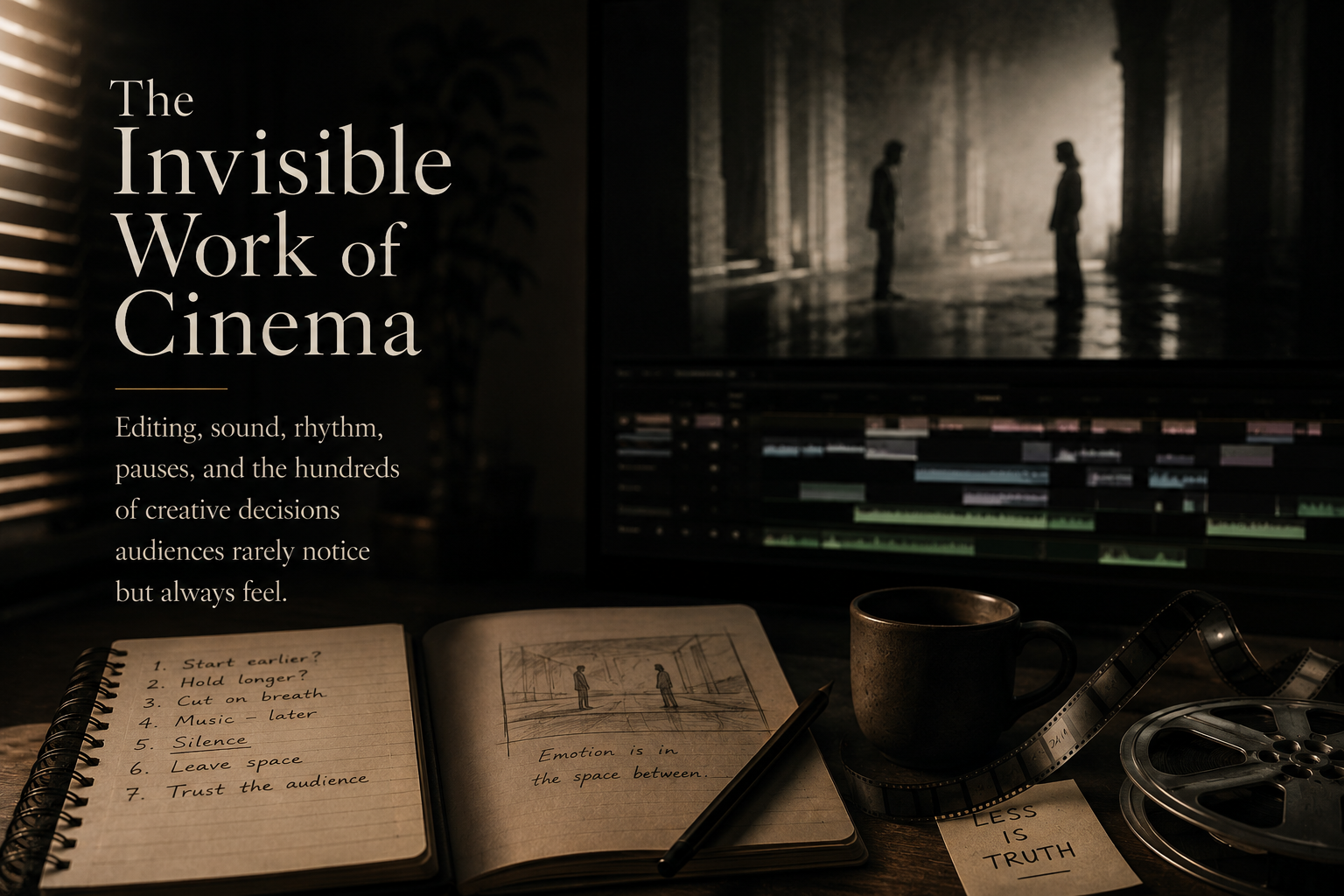
How editing, sound, rhythm and countless unseen decisions quietly shape the emotional experience of watching a film.
One of the quiet pleasures of watching a film with an audience lies in observing the moments that move them most. A room full of strangers grows unexpectedly still. Someone laughs a fraction before everyone else. A hand reaches almost instinctively for another. The credits begin and people stay seated a few moments longer than necessary, as if reluctant to leave the world they have lived in for the past two hours. Afterwards they talk about the performances, the story, the music, or a particular scene that will not let go of them. Almost nobody says, "That cut at one minute and thirty-eight seconds was inspired," or, "Removing thirty frames before the close-up changed the emotional trajectory of the whole sequence." They are almost certainly right, of course. They just don't know it.
Cinema may be the only major art form whose greatest achievements are designed to disappear. Invisible craftsmanship is not unique to film, but no other art depends on it so completely. A reader notices language. A concert audience listens consciously to music. Gallery visitors stand in front of the painting itself. Film asks for something different. It wants writing, performance, cinematography, editing, sound, production design, and music to dissolve into a single emotional experience. We remember the story. The craft succeeds precisely because we stop noticing where one discipline ends and another begins.
A well-written sentence announces itself, even quietly. A fine piece of music is hard to ignore. A painting hangs on a wall asking to be looked at. The best editing, by contrast, leaves almost no trace of itself. It convinces us that events unfolded exactly as they should have, hiding the sheer number of decisions that made the illusion work. Like a good butler in an English country house, its highest ambition is to do essential work while drawing as little attention to itself as possible. This invisibility is what has always drawn me to the subject.
A film does not begin when the camera starts rolling. It starts much earlier, and keeps going long after. Every finished scene represents hundreds of decisions, most of them so small they look insignificant on their own. Should the camera arrive a second earlier? Should the actor start walking before speaking? Does the music come in now, or wait until after the silence? Is the pause before the reply too long, or not quite long enough? Should the audience learn this now, or twenty minutes from now? None of these questions looks especially dramatic by itself. Together they decide whether a scene simply functions or finds its way into memory.
Editing might be the purest example of this hidden craft. There is a comfortable misconception that editors assemble a film roughly the way one assembles flat-pack furniture: the pieces already exist, they just need patient sorting. The truth is more interesting than that. Editing is where a film finds its rhythm, and rhythm, though it resists precise measurement, decides almost everything the audience ends up feeling. Walter Murch has written that editing succeeds by serving emotion above everything else, and the claim gets more convincing the longer one spends in an editing room. Technical precision matters a great deal, but audiences rarely remember technical precision. They remember how a scene made them feel. Everything else works quietly in service of that.
A conversation can be technically flawless and still feel dead because the pauses were shortened by half a second. A reaction that lands a beat too late turns sadness into melodrama. A cut made a moment too early interrupts a thought the audience had only just begun to follow. These differences are almost impossible to name consciously while watching, yet they shape how we feel with startling consistency. We notice the result and never notice the cause.
The simplest way to understand editing might be to think about an ordinary conversation. Imagine telling a friend that someone you love has just left home for good. The words matter, certainly, but so does everything around them: the hesitation beforehand, the moment spent looking away, the breath taken before speaking. Even silence has its own grammar. Take out those pauses and the conversation changes completely. Cinema works the same way. Images carry meaning on their own, and gain emotion through their relationship with each other.
That relationship between images has always struck me as close to miraculous. A close-up of an elderly man looking through a window says one thing. Follow it with children playing in a garden and the audience feels nostalgia. Follow the same shot with an empty hospital corridor and the emotion changes entirely. Nothing about the man's expression has moved. The meaning lives in the gap between images rather than inside either one. Cinema is constantly asking the audience to finish invisible connections, and audiences do this without the slightest sense that they are doing anything at all.
Sound works the same trick with equal subtlety. We tend to think of film sound as dialogue and music, since they announce themselves most loudly. But much of what shapes a scene sits beneath conscious attention: a dog barking somewhere off frame, wind moving through trees, the low hum of electricity inside an empty building, footsteps continuing after a character has left the shot. Take these away and the world starts to feel strangely artificial, though most viewers would struggle to say why.
Silence is stranger still. Most people assume silence just means the absence of sound. Cinema treats it as something else entirely. A room is never truly silent — there is always breathing, distant traffic, the rustle of clothing, birds beyond an open window, rain on glass. More to the point, silence builds expectation. It sharpens the audience's attention with real efficiency. The moment the music drops out, people start listening harder. The absence itself becomes expressive.
This is one reason I have always admired filmmakers confident enough to resist explaining everything. Music can be extraordinarily beautiful and still become a kind of emotional punctuation, gently informing the audience that sadness has now officially arrived and should be acknowledged. The best scores understand restraint. They come in almost shyly, leave just as quietly, and trust a scene to exist on its own without constant accompaniment. A melody remembered is nearly always more powerful than one that insists on being heard.
Rhythm reaches well past editing and music. Whole films have rhythm, the way novels have prose style. Some move fast, driven by urgency. Others breathe slowly, favouring observation over action. Neither approach is better on its own. Trouble starts only when the rhythm stops matching the emotional life of the story. A film about grief cannot always be rushed. A comedy that pauses too long risks turning into an accidental study of awkwardness. Every story has its own tempo, and much of filmmaking is a matter of finding it rather than forcing one in from outside.
Directing has taught me patience that reaches well beyond film itself. The temptation to improve a scene by adding one more line, another camera move, one more piece of music is almost impossible to resist. Experience keeps suggesting the opposite. Films, like people, sometimes get more eloquent once they stop talking.
The longer I have worked in cinema, the more convinced I have become that audiences are sharper than we give them credit for. They may not identify the exact reason a scene affects them, but they almost always sense when something rings false. A film can have beautiful cinematography, strong performances, and flawless production values and still leave us oddly untouched, because somewhere inside its invisible machinery a hundred small decisions are pulling in slightly different directions. The audience never says, "the rhythm is inconsistent," or "the soundscape feels disconnected." They just leave the theatre saying the film never quite came alive. That offhand verdict is usually right.
It is tempting to think of filmmaking as a set of separate crafts: writers, cinematographers, editors, composers, sound designers, actors, colourists, each handing off their piece before stepping aside for the next department. In practice the boundaries dissolve almost immediately. The editor starts shaping performances. The composer alters the rhythm of a scene. The cinematographer influences how dialogue gets delivered. Sound changes how big a room feels. Colour affects the emotional temperature long before the audience consciously registers it. Cinema is less a stack of separate disciplines than a conversation between them, and that conversation only works if everyone listens as hard as they speak.
Colour is a particularly slippery participant in that conversation. Ask most viewers whether a scene leans warm amber or cool blue-grey and many would hesitate. Change those colours, though, and the emotional atmosphere shifts almost instantly. A room lit by late-afternoon warmth carries a completely different charge from the same room under cold fluorescent light. We respond before we analyse. The eye notices first. The mind catches up later. Colour grading, then, has very little to do with making an image attractive. It is about emotional climate, shaping how the audience inhabits a world without ever being told they are being shaped.
Framing does something similar. Two characters seated across a table, photographed together in one frame, suggest connection even through disagreement. Split them into separate frames and the distance between them becomes tangible. Push the camera a little closer and intimacy appears. Pull back a few feet and loneliness starts entering the shot. The audience feels these shifts instinctively. Almost nobody leaves the cinema talking about lens choices, and those choices have been steering their emotions since the opening shot.
Performance may be where invisible craft shows itself most. Audiences rightly praise actors, but a performance is never built by the actor alone. It is shaped by where the camera sits, how long it holds, what got cut, and what surrounds it in the sequence. A glance lasting three seconds might have needed twenty takes, each different by barely perceptible degrees. Somewhere in the editing room one version emerged as true while the other nineteen, though technically excellent, did not. The audience sees only the final glance. Behind it sits an enormous weight of judgement they will never see.
There is a curious contradiction at the heart of filmmaking that I have always found myself smiling at. Success is usually measured by how completely the audience forgets the effort behind it. Nobody watches a beautifully built scene hoping to admire the organisation that produced it. The hidden labour has done its job exactly because it stays hidden. If viewers become sharply aware of editing, sound, or camera movement, it is usually because those elements have started demanding attention that rightly belongs to the story. Technique works hardest when it disappears into feeling.
That disappearing act extends even to moments that look entirely spontaneous. A child laughing at exactly the right instant. Rain starting as two characters say goodbye. A silence that feels completely natural. Such moments often come out of countless conversations, rehearsals, and revisions. Spontaneity, oddly enough, tends to require serious preparation. The audience gets immediacy. The filmmakers usually spent months building the conditions that made it possible.
There is one more invisible element worth naming, and it has nothing to do with cameras or editing suites. It is trust. Every film asks its audience to trust that each decision was made for a reason. And every filmmaker has to trust the audience enough to leave some things unexplained. We live in an age fond of explanation. Characters describe emotions already visible on their faces. Music confirms feelings we recognised scenes ago. Endings arrive with tidy summaries attached, as if ambiguity were somehow rude. But the moments that stay with us longest usually owe their power to restraint: a pause left alone, a question left unanswered, a face holding several emotions at once without announcing which one should win.
The older I get as a filmmaker, the less interested I become in adding things and the more interested I become in taking them away. Every added line of dialogue narrows interpretation. Every explanatory scene shrinks the audience's role. Every unnecessary cut interrupts a rhythm that may already have found its natural pace. Restraint gets mistaken for simplicity, but it is really the product of confidence. Knowing what to leave out usually takes more judgement than knowing what to put in.
This may be why cinema keeps its hold on me after all these years. It is an art form built out of thousands of small acts of judgement, none of them dramatic on its own, all of them transformative together. A film succeeds because countless people spent months weighing details the audience will never consciously register: the length of a pause, the colour of evening light, the distant sound of wind past a doorway, the exact frame a scene should end on. None of those decisions matters much in isolation. Together they become the film's emotional architecture.
When the lights come up and someone says, "I don't know why, but that scene stayed with me," they have paid cinema its highest compliment without meaning to. They are responding to work that has dissolved completely into feeling. The editing is gone. The sound is gone. The rhythm, the colour, the framing, and the hundreds of invisible decisions behind them have all given up their separate identities so the story alone can remain. That, I think, is the strange beauty of filmmaking. The greatest labour is usually the least visible, and the finest craft is measured not by how much of itself it shows, but by how completely it lets us forget it was ever there.
AK Srikanth is an Indian novelist, filmmaker and essayist whose work explores storytelling across literature, cinema and performance. He is the author of A Song for Eresha and writes from the Nilgiris in southern India.
Related Essays