
The Long Road To A First Novel
THE WRITING SERIES
What writing a first novel taught me about patience, revision, memoir, fiction and the slow craft of becoming a writer.
People occasionally ask how long it took me to write my first books. The question sounds simple enough, and I usually give the answer social convention expects. A couple of years, I say, which is factually accurate in much the same way that saying a tree took fifty years to grow ignores the rather important contribution of sunlight, rain, and an enormous amount of patience. Books have a habit of beginning long before their authors notice them. By the time the first sentence finally lands on a blank page, the story has often been travelling through one's life for years, collecting fragments, observations, conversations, and emotions with the unhurried confidence of something that already knows it will arrive.
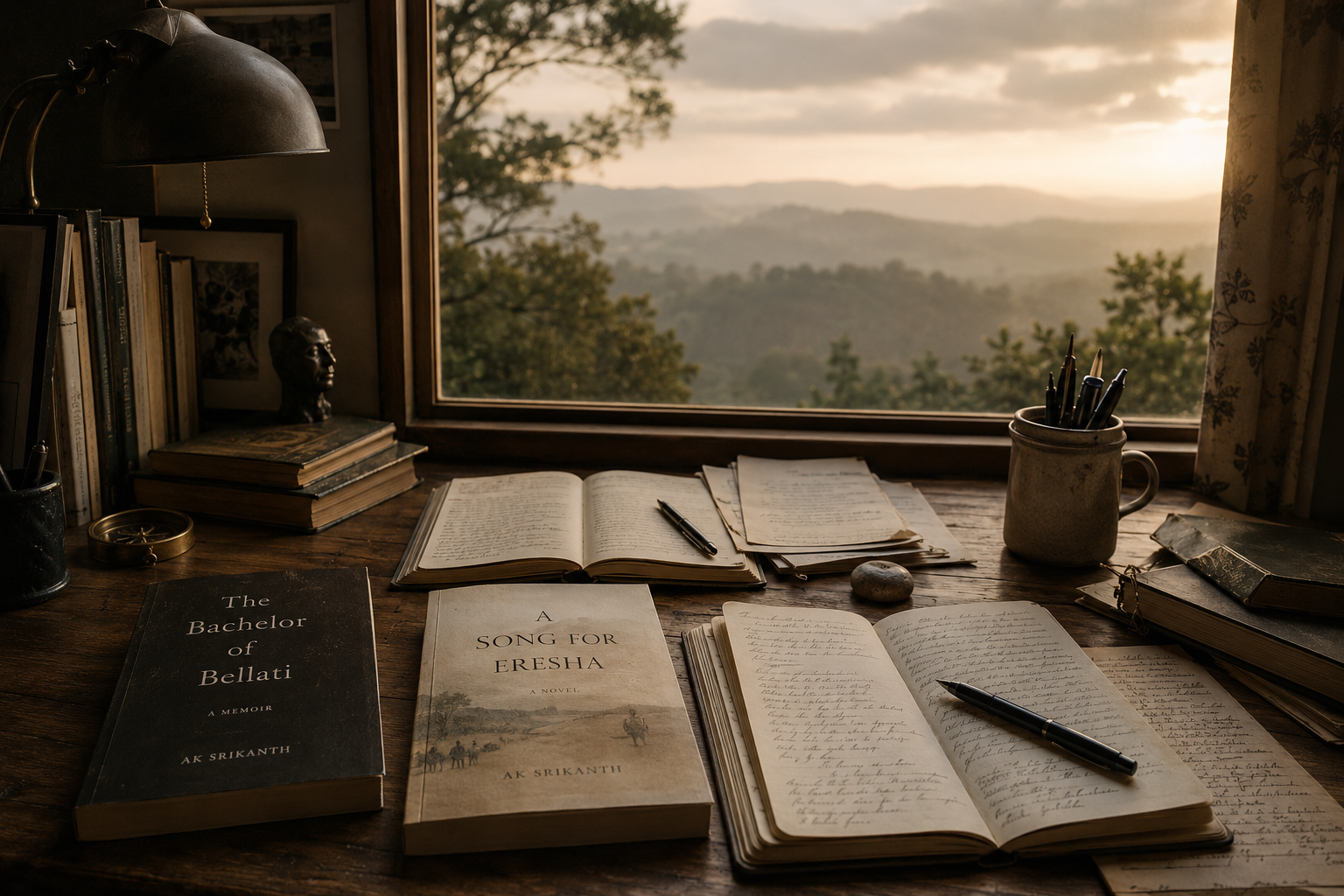
When I began writing The Bachelor of Bellati and A Song for Eresha, I imagined they would occupy separate corners of my life. One was a memoir rooted in memory and lived experience. The other was a novel demanding the invention of an entirely new world, with its own people, relationships, and emotional truths. They seemed to require different instincts. One asked me to remember. The other asked me to imagine. It took surprisingly little time to discover that the distinction was mostly imaginary. Memory has always been more inventive than it admits, and fiction has a habit of borrowing from life without asking permission.
The two manuscripts soon began sharing the same desk, the same mornings, and occasionally the same anxieties. There were days when I spent hours trying to recover the exact rhythm of a conversation that had taken place years earlier, only to discover the next morning that an entirely fictional character had begun speaking with unexpected clarity. On other days I would become so immersed in the emotional lives of imagined people that a forgotten incident from my own past would return on its own, offering itself with a generosity it had refused when I went looking for it directly. The memoir and the novel seemed to have entered into some private arrangement I was not invited to join.
Every manuscript teaches its author how to write the one book it is capable of becoming, and the lesson never arrives until the author has become thoroughly convinced of knowing what they are doing. My confidence lasted, in each case, roughly the length of a respectable opening chapter. After that the books took over. They rejected scenes that had seemed perfectly sensible in outline, demanded conversations I had not anticipated, and led me toward conclusions that looked obvious only once they had already been written. One begins believing oneself the architect. It becomes apparent, gradually, that one has actually been hired as the site supervisor.
Writers are widely believed to spend their days waiting for inspiration, an idea that survives largely because it sounds more romantic than the truth. Inspiration does visit from time to time, though it keeps no regard for ordinary working hours and no interest in deadlines. Most of writing consists of returning to the same chair each day whether or not inspiration has chosen to come along. Some mornings the sentences arrive with confidence. Others behave like reluctant schoolchildren being marched toward a mathematics exam. Persistence earns a writer's respect precisely because it stays available on the days talent has taken the day off.
Working on two books at once meant that discouragement in one manuscript often became the cure for the other. A chapter refusing to cooperate in the memoir would send me, gratefully, toward the novel instead. A stubborn scene in the novel would push me back to the memoir, where memory, unreliable as it can be, at least offered the comfort of events that had already happened. Each book, I realise now, became a refuge from the other. Neither gave me quite enough time to grow despondent.
People sometimes imagine that writing moves in a reassuringly straight line: Chapter One, then Chapter Two, proceeding in orderly fashion until the acknowledgements announce that everyone may go home. My own experience bore little resemblance to that kind of order. Entire chapters sat untouched for weeks while a scene near the end demanded immediate attention. Characters introduced almost casually in an early draft acquired unexpected weight, while others I had placed real confidence in quietly left with scarcely a farewell. The books understood their own architecture better than I did. My job was less to control them than to notice where they wanted to go.
That surrender turned out to be one of writing's least discussed pleasures. Much of life is spent trying to organise, predict, and manage outcomes, and stories have very little patience for any of that. They run on emotional logic instead of administrative convenience. A conversation that looked insignificant becomes indispensable. A carefully planned subplot evaporates because it no longer belongs. A single sentence, written almost absent-mindedly, turns out months later to hold the emotional centre of the entire book. The work develops an intelligence of its own, and the writer's job becomes listening rather than speaking.
There were stretches, naturally, when I wondered whether either manuscript would ever be finished. Every long project eventually reaches a point where the destination disappears under the sheer accumulation of unfinished pages. Progress starts to feel like excavation rather than creation. One spends the morning moving paragraphs from one chapter to another, the afternoon deleting half of what seemed excellent the night before, and ends the day suspecting that literature might have advanced faster had one taken up gardening instead. Plants, in my limited experience, rarely object to being watered the way manuscripts object to being edited.
Even in those uncertain stretches, something kept pulling me back. Discipline played its part, but the larger reason was that these books had become companions. They occupied my thoughts on walks, interrupted unrelated conversations with inconvenient ideas, and occasionally solved themselves while I was making tea, which suggests kettles deserve more credit than they get in discussions of the creative process. Living with a manuscript for several years means its characters stop visiting occasionally and start paying rent. They accompany ordinary days with real persistence, until one almost forgets they are fictional.
The most valuable lesson those years taught me had very little to do with writing technique. It was about patience. Modern life sells the comforting idea that worthwhile things should happen fast. We have grown used to instant replies, same-day deliveries, and the strange expectation that every ambition should arrive with a tracking number attached. Books run on a different calendar. They mature at a pace entirely indifferent to ours, and refuse to be rushed simply because their author has run out of patience. That fact was frustrating at first. It became liberating later.
Patience, I eventually discovered, is not merely the willingness to wait. It is the willingness to keep working while waiting, often with no assurance the work will ever find its readers. Every writer begins with an audience of one. The manuscript lives in a strange kind of privacy: it occupies the desk, the mind, and an unreasonable share of one's waking hours, while remaining invisible to everyone else. Friends ask how the book is going and one answers with rehearsed optimism, leaving out the detail that Chapter Nine has spent the last fortnight arguing with Chapter Ten over something neither will explain.
There comes a point in every long manuscript when familiarity becomes the biggest obstacle to seeing it clearly. After the same pages have been read dozens of times, individual sentences stop registering at all. Whole chapters pass before the eye with the comfortable blankness of a road driven every morning. It becomes impossible to tell whether a scene carries genuine emotional force or simply benefits from having lived in one's imagination for so long. The writer starts studying early readers' reactions with an intensity that would look alarming in almost any other line of work. A raised eyebrow takes on significance. A thoughtful silence after a chapter becomes something to turn over for days. Eventually every manuscript has to leave the closed circuit of its author's imagination if it is going to become a living thing.
Revision is where writing sheds its own mythology. First drafts enjoy an undeserved reputation for magic, as though novels arrive whole and simply need someone fast enough to type them down. My experience suggested something far less glamorous. The first draft only proves the book exists. Everything worth doing happens after that. Every page starts asking hard questions. Every chapter has to justify its place. Whole scenes disappear because they no longer serve the story, despite having taken several exhausting days to write in the first place. A writer learns, slowly, to part with sentences they had admired for their elegance once it becomes clear that elegance is a poor substitute for purpose. It is an education in humility wearing the disguise of editing.
Writers from John le Carré to Hilary Mantel have described the same realisation: the first draft is less an act of completion than of discovery. Only revision reveals what the manuscript had been quietly trying to become all along. This is probably the stage that most separates writing from the romantic idea people have of it. The first draft belongs to instinct. Revision belongs to judgement. One discovers; the other discerns. Writers talk about "finding" a book, but more often the book is found several drafts later, once enough unnecessary pages have stepped aside to reveal the story that had been waiting underneath them the whole time.
Working on a memoir and a novel at once taught me a distinction I had never considered before. The memoir asked whether I was remembering honestly. The novel asked whether I was imagining honestly. At first these looked like entirely different disciplines. The difference grew smaller the longer I worked. Readers have an uncanny instinct for emotional truth. They will forgive improbable events, unlikely coincidences, and the odd narrative liberty, but they rarely forgive a character behaving for the author's convenience instead of out of the complexity of an actual human being. Whether the people on the page once existed or were invented from nothing turns out to matter far less than whether their inner lives convince us. Everything else follows from that.
Memory, for its part, proved both generous and maddening. Certain episodes came back with startling precision, complete with the texture of a room, the rhythm of a conversation, the particular quality of afternoon light across a window. Others refused every attempt at retrieval. The harder I chased them, the further they seemed to withdraw. Eventually I stopped chasing so hard, and, oddly, many of them returned on their own weeks later, while I was doing something else entirely. Memory dislikes being interrogated. It responds far better to being left alone in good company.
Fiction asked for something different: faith. One spends months worrying about people who never existed, fretting over decisions they have not yet made, and feeling unreasonably relieved when an imagined conversation finally lands on the right ending. Said aloud, the whole enterprise sounds a little absurd, which is probably why writers avoid bringing it up at dinner parties. But somewhere in those years Eresha and Anvesha stopped feeling invented. They took on the ordinary familiarity of people whose company had become part of daily life. Their world filled long walks, interrupted unrelated thoughts, and occasionally solved its own problems while I made tea, further evidence that kettles are underrated collaborators.
Completion, when it came, arrived far more quietly than I expected. There was no dramatic moment of triumph, no sense of a mountain finally scaled. Instead there was an unexpected stillness. For several years these books had shaped almost every ordinary day, filling early mornings, interrupting evenings, following me through journeys, conversations, and solitary walks. Finishing them felt something like watching old neighbours move away after many years. One is glad to see them start the next chapter of their lives, and still a little thrown by the silence they leave behind.
The harder lesson comes right afterward. Every manuscript eventually reaches the point where it stops belonging entirely to its author. It has to leave the study and begin its own conversation with strangers. Readers find meanings that were never consciously intended. They linger over passages the author barely remembers writing and skim past others that cost weeks of effort. Some see themselves in unexpected places. Others land on conclusions the author never anticipated. That is not a failure of communication. It is what finishes a book. A manuscript is never really done when the writer sets down the final full stop. It is done only when another reader starts carrying it through the landscape of their own life.
The years spent writing these two books are now inseparable from the person they shaped. One taught me to look inward more honestly. The other asked me to imagine lives well beyond my own. Together they dismantled the comfortable idea that writing is mainly an act of expression. It is just as much an act of listening: to memory, to imagined voices, to moments that seem insignificant when they happen and only reveal their weight much later. Above all, one listens to the manuscript itself, which usually knows what it wants to become months before its author catches up.
People still ask how long it took to write my first books, and I still give the convenient answer, because conversations generally go better when they are short. The fuller answer is different. Counting from the first sentence, perhaps two years. Counting from the experiences, observations, conversations, failures, and small moments that slowly gathered until those first sentences became possible, considerably longer. Stories rarely begin where we assume they do. They spend years collecting themselves inside ordinary lives, and by the time the first sentence finally lands on the page, it only looks like a beginning. It has been arriving for years.
AK Srikanth is an Indian novelist, filmmaker and essayist whose work explores storytelling across literature, cinema and performance. He is the author of A Song for Eresha and writes from the Nilgiris in southern India.
If this resonated