
THE CREATIVITY SERIES
The Solitude Of Making Something
What does it mean to live with an idea that no one else can yet see? An essay on creativity, uncertainty, perseverance and the hidden psychology of making art.
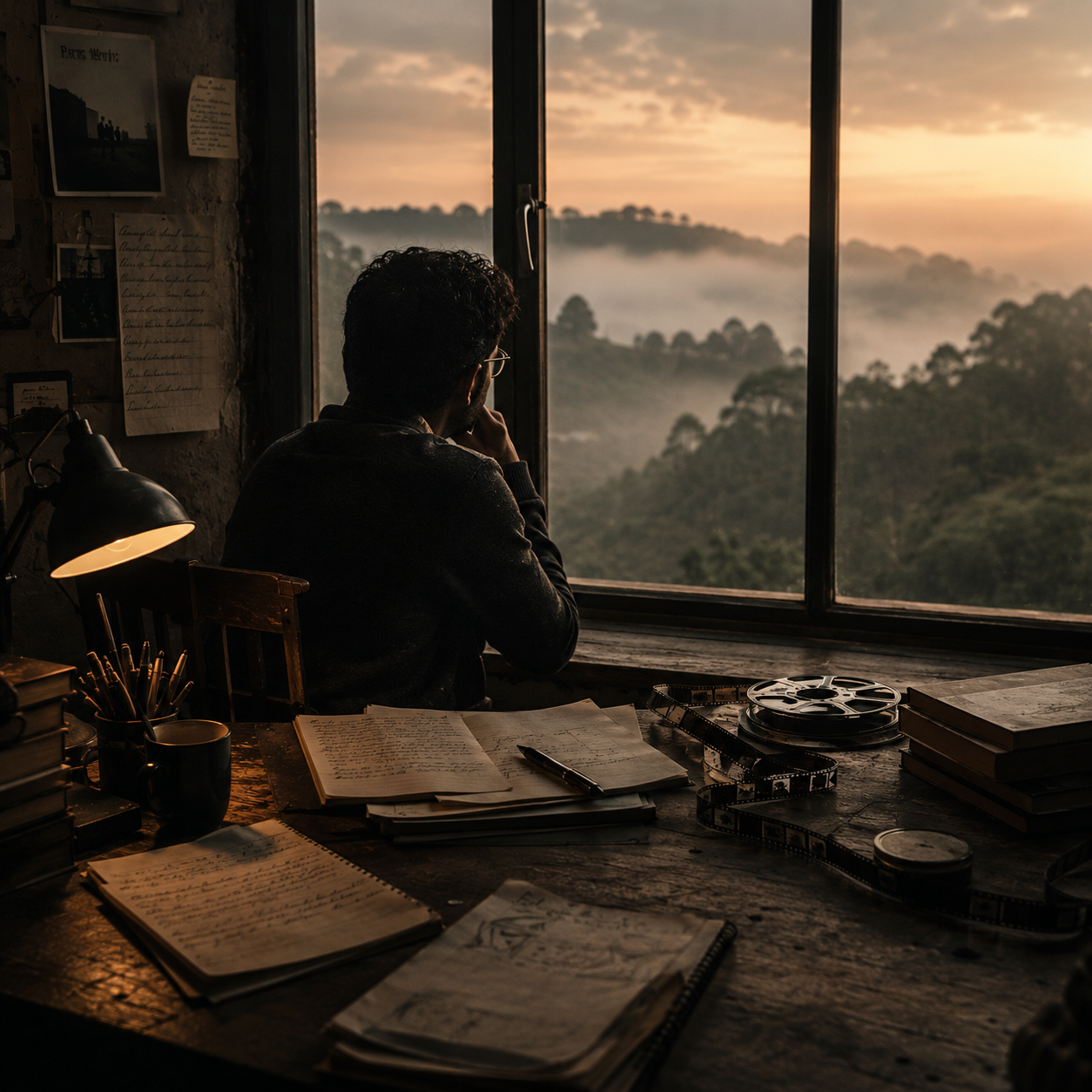
There is a peculiar kind of loneliness that comes with every creative endeavour, and it has very little to do with physical solitude. One may write in a bustling café, compose music in a busy studio, or edit a film surrounded by colleagues, and still inhabit a world entirely inaccessible to everyone else in the room. Every meaningful work exists first as an interior landscape. Before it becomes a book, a painting, a film, or a piece of music, it lives only inside the imagination of its creator, carrying a strange mixture of certainty and doubt. One knows it exists. One cannot yet prove it.
This is the least visible part of making anything. Audiences meet the finished work neatly bound, carefully edited, or projected on a screen, and see confidence where, for months or years beforehand, uncertainty occupied the same space. A finished work always carries an illusion of inevitability, as though it could never have turned out any other way. The creator remembers a different history: abandoned beginnings, rewritten chapters, discarded scenes, and countless mornings spent wondering whether the thing being attempted deserves to exist at all.
Ideas rarely announce themselves with the confidence we later grant them. They arrive modestly. A conversation overheard while waiting for a train. The look on someone's face after a phone call. An old house glimpsed from the road whose occupants one never meets. Most disappear almost immediately. A few refuse to. They return the next day, tag along on a walk through the hills, interrupt unrelated thoughts, and gradually take up more space than politeness ordinarily allows. Eventually ignoring them costs more effort than listening.
Annie Dillard once said the writing life is less a profession than a way of paying attention. That holds well beyond literature. Whatever the medium, creative work begins with a heightened awareness of the ordinary. The smallest gesture, an overheard conversation, a passing shaft of afternoon light, may turn out to be indispensable months later.
The trouble is that, in these early stages, nobody else can see what has become so vivid to the creator. Explaining an unfinished idea is a bit like describing a dream remembered only in fragments. One talks enthusiastically about atmosphere, characters, and possibilities, while quietly knowing that none of it yet has the coherence needed to persuade anyone else. Friends ask what the story is about. One answers with real conviction, then goes home entirely unconvinced by one's own explanation. The work exists. It just refuses to show itself in ordinary conversation.
This may be why making something demands an unusual kind of faith. Not faith in success, which stays largely out of one's control, but faith that an invisible thing can eventually become visible if the work continues long enough. That faith is fragile in odd ways. It survives ordinary setbacks with real resilience, then gets shaken by something small: a difficult afternoon, a chapter that suddenly looks dreadful after seeming fine the night before, a scene that will not find its ending. Creative confidence behaves rather like British weather. One learns quickly not to trust today's forecast too much.
Confidence, contrary to what people assume, rarely comes before the work. More often it follows. The artist seldom begins with certainty. Certainty tends to be the reward for having carried on without it. Every worthwhile project seems to demand a stretch during which belief has to exist without much evidence to support it, and that uncomfortable stretch is often exactly where the work finds its deepest foundations.
There are stretches when the work moves with reassuring clarity. Pages pile up. Characters start surprising their creator. Connections appear where none had been consciously planned. Days like this tempt one into believing the hard part is behind them. Experience says otherwise. Every substantial piece of work eventually reaches a point where progress becomes nearly invisible. One keeps showing up each morning with no convincing evidence that yesterday's effort brought completion any closer. It is in these stretches that persistence quietly takes over from enthusiasm as the thing actually driving the work forward.
Modern life has little patience for that kind of invisible progress. We have grown used to measurable outcomes, instant feedback, reassuring signs that effort is producing results. Creative work resists all of that, almost on principle. One can spend a whole week removing rather than adding, simplifying rather than expanding, and end up with fewer pages than existed at the start. To anyone watching from outside, nothing has happened. The creator often knows the work advanced further during those invisible days than during weeks of visible output.
Another kind of solitude sets in as the work grows more substantial: the creator starts living in two worlds at once. Ordinary life carries on with total indifference. Groceries need buying. Emails need answering. Friends ask if one is free for dinner next Thursday. Alongside these entirely reasonable demands, another existence keeps unfolding. Characters pick up conversations left unfinished the previous afternoon. A problem solved on a walk through town quietly rearranges the next chapter. The work tags along on every ordinary errand. One becomes physically present while mentally hosting visitors from a different world altogether.
This double life produces its share of unintended comedy. It is entirely possible to look deeply engaged in a conversation about household repairs while privately working out the ending of a novel. Creative people tend to get remarkably good at disguising these brief absences. The people who live with them deserve more credit for tolerating it than they usually get.
The solitude of making something, then, is not an absence of company. It is the private responsibility of carrying an invisible world until it is ready to exist without you. Nobody else can take that on. Advice helps. Encouragement matters. But the work itself has to pass through the mind and hands of the person making it, and there comes a point in every medium where the next sentence, the next brushstroke, the next note, the next cut belongs to no one else.
Oddly enough, this solitude stops feeling like a burden after a while. Given enough time it starts to feel more like company. The work occupies mornings, interrupts walks, turns up unexpectedly while the kettle is on, and arranges itself around the ordinary rhythm of the day. One stops thinking of it as a project and starts recognising it as a place, somewhere visited daily with growing familiarity. Like any place worth returning to, it reveals more of itself to those willing to stay a little longer.
The strange thing about carrying an idea for a long time is that it slowly starts carrying you back. What began as an act of creation turns into an education in observation. One starts noticing conversations that might once have gone unremarked, pauses between people that say more than their words do, expressions that flicker and vanish before social politeness has time to smooth them over. The world becomes part of the work. A creator picks up the mildly inconvenient habit of never entirely switching off, and every ordinary day starts handing over small gifts whose significance may not show itself for months, sometimes years.
There is a quieter consequence to living with unfinished work for a long stretch: the work keeps changing because its creator does. An idea that felt entirely convincing two years ago suddenly needs revising, not because it was poorly conceived, but because the person coming back to it has become someone else. This is one of the hidden reasons serious creative work resists being rushed. Time is not just passing around the manuscript, the screenplay, or the score. It is passing through the person making it. The work matures because the maker does.
This has always struck me as one of the great paradoxes in the whole business. We begin believing we are shaping the work. Gradually it becomes clear the work has been shaping us too. Every difficult project asks uncomfortable questions. Have you really understood this character? Is this scene true, or just convenient? Does this ending grow naturally out of everything before it, or have you simply gotten impatient to reach the last page? These questions rarely stay confined to the manuscript. They start bleeding into the habits of thought a person carries into the rest of their life.
Stepping away from a serious piece of work is seldom as simple as putting it in a drawer. Even when one deliberately steps back, the idea keeps living somewhere else. It turns up on a walk. It comes back while driving home in the rain. It rearranges itself while one is doing something entirely unrelated. Solutions have a stubborn dislike of arriving when invited. They seem to prefer showing up while the dishes are being washed, the kettle is on, or in the first few minutes after waking, as if creativity had privately decided that ordinary schedules were beneath it.
There are also stretches when nothing appears to happen at all, and these can be genuinely unsettling. Days pass with no sentence worth keeping. Chapters resist every attempt at improvement. One starts wondering whether the work has reached the edge of what it can be, or whether the edge belongs entirely to the person working on it. These stretches feel lonely in part because they are almost impossible to explain to anyone standing outside the process. From the outside, nothing has changed. From the inside, one is negotiating daily with doubt.
Yet these apparently barren stretches often turn out to be generous ones. Creativity has a rhythm that has little to do with productivity. We tend to treat visible progress as the whole story because visible progress is easier to measure. Much of the real work happens beneath the surface. Connections quietly form between ideas that once seemed unrelated. A character gains emotional depth without a single new page written. An ending that resisted every conscious attempt at resolution suddenly turns up looking so simple that one wonders why it stayed hidden this long. The work never stopped. It just preferred working somewhere it could not easily be watched.
Eventually the solitude ends. The manuscript is sent. The film is screened. The painting leaves the studio. Music that existed privately for years is finally heard by strangers. One might expect this to be a straightforward relief. It rarely is. Alongside the excitement comes a strange vulnerability. Something that has lived privately inside one's own mind now belongs to other people. They will read it through their own lives, find meanings that were never consciously intended, and possibly skip right past passages that once seemed essential. Creation always ends in an act of letting go.
I have come to believe that this surrender is not the end of the creative process but its point. A story kept entirely to its creator stays incomplete, however beautifully made. Art becomes fully alive only once another imagination enters it. A reader finds a character who reminds them of someone they once loved. A viewer finds comfort in a scene the filmmaker never expected to matter to anyone. A piece of music accompanies someone through grief, joy, or an ordinary Tuesday afternoon. The work slips its origins and starts collecting lives beyond the one that first imagined it.
That possibility, more than publication, exhibition, or applause, is what seems to justify the years spent alone with it. Every creator starts out carrying an invisible world nobody else can see yet. The hope was never simply to finish it. The hope is that someday a total stranger will recognise a fragment of themselves inside it. Two people separated by distance, circumstance, and experience briefly meet inside a story. Few things feel less likely, or quietly stranger, than that.
The solitude of making something is not a flaw in the process. It is part of what the process is. Every meaningful work begins as a private conversation before it becomes a public one, and the years spent carrying an unseen idea are not empty years spent waiting for success. They are the years the work spends finding its shape, while its creator learns the patience, humility, and attention it takes to bring anything into the world at all.
I think often of a woman I have never met, somewhere, who will one day open a book I wrote alone at a desk years before she was thinking about it at all, and find in it a sentence that seems to have been waiting for her specifically. She will have no idea about the mornings that produced it, the chapters that were thrown out to make room for it, the years it spent as nothing more than a feeling I could not yet explain to anyone, including myself. None of that will matter to her, and it shouldn't. What started as the loneliest thing I have ever done will have become, for a stranger, a kind of company. That trade has always seemed to me the whole point of doing this at all.
AK Srikanth is an Indian novelist, filmmaker and essayist whose work explores storytelling across literature, cinema and performance. He is the author of A Song for Eresha and writes from the Nilgiris in southern India.
Related Essays