
THE STORIES SERIES
Why the greatest films reward patience, attention and repeated viewing, and what literary cinema teaches us about the art of truly seeing.
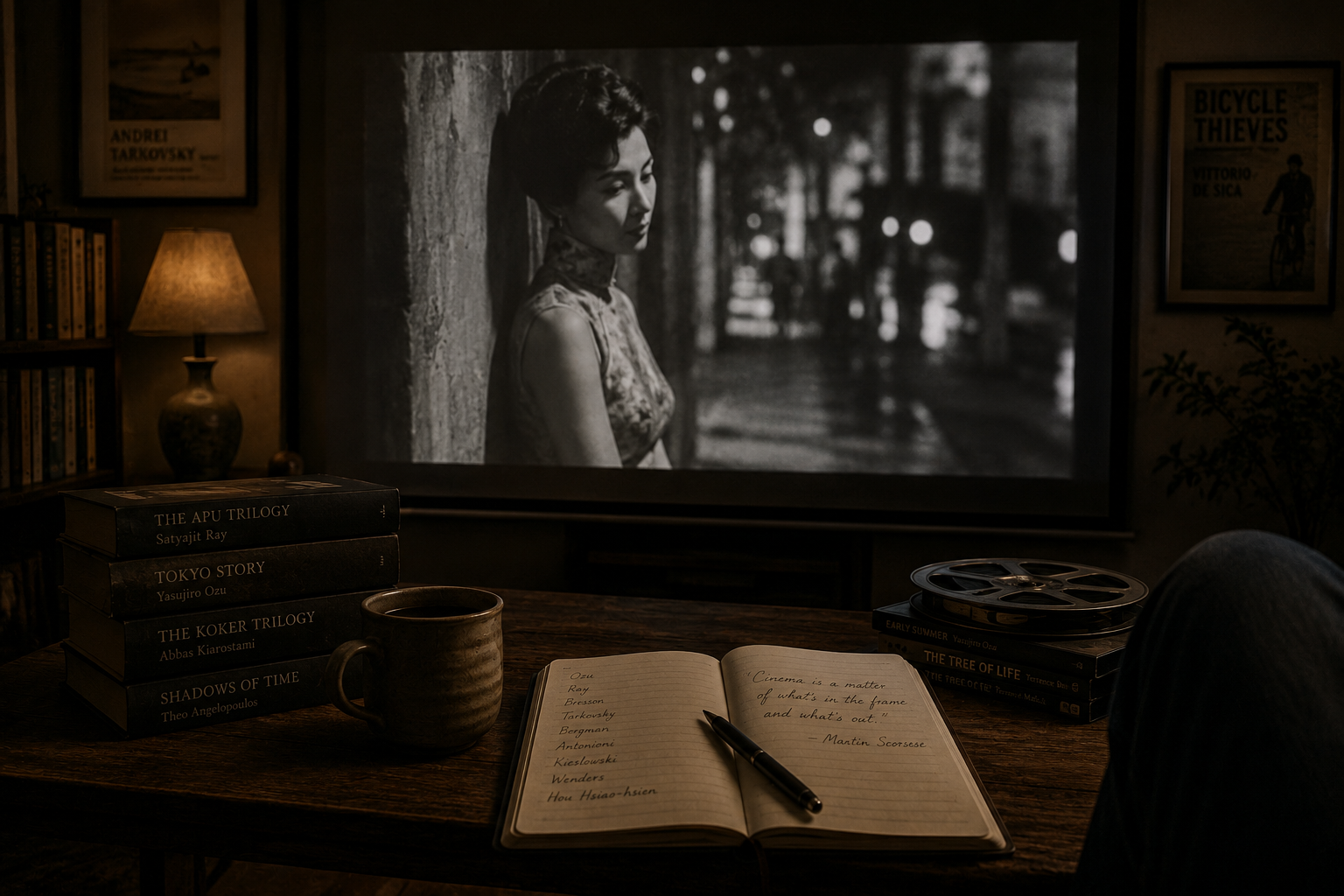
Watching Films Slowly
There was a time when watching a film involved a modest degree of commitment. One travelled to a cinema, found one's seat with varying levels of dignity depending on how dark the auditorium had already become, and surrendered the next two hours to a story over which one exercised no control whatsoever. There was no pause button. Nobody consulted a telephone midway through a conversation of considerable emotional importance. If one happened to miss a line of dialogue because somebody in the row behind had chosen precisely that moment to unwrap a sweet with geological patience, one accepted the loss and moved on. The film moved forward regardless. So, eventually, did we.
We now carry thousands of films in our pockets, and watch them, on average, with less attention than earlier generations gave to a weather forecast. A film today competes with messages, headlines, social media, deliveries at the door, and the conviction that every moment ought to hold several activities at once. Cinema, at its finest, has never rewarded that kind of impatience.
Watching is too small a word for what a great film asks of us. We listen to silence. We watch faces think before they speak. We register the changing quality of light in a room, and understand that the distance between two people across a dining table can say more about them than several pages of dialogue would. Cinema is a language, and like every language it has to be learned rather than simply overheard.
Yasujirō Ozu lingers on an empty room after the people in it have left. Satyajit Ray lets a landscape breathe before returning to the characters standing in it. Abbas Kiarostami finds whole conversations inside roads, trees, passing clouds. Balu Mahendra understood, perhaps better than almost anyone, that silence could carry as much weight as dialogue, provided the director trusted the audience enough to hold it. Directors like these leave gaps on purpose. They assume the viewer has an imagination of their own and will use it.
That trust is getting rarer. Contemporary cinema often behaves as if the audience will drift off unless something dramatic happens every few minutes. Explanations arrive before the questions have finished forming. Characters announce feelings their faces had already made obvious. Music tells us exactly what to feel, in case independent thought should break out somewhere in the auditorium. Films, increasingly, seem less interested in inviting interpretation than in ruling out misunderstanding.
And yet some of the most memorable moments in cinema exist precisely because they refuse to explain themselves. The final smile in The Third Man. The closing freeze-frame of The 400 Blows. The rain-soaked farewell in In the Mood for Love. The ending of Taste of Cherry. None of them rushes to reassure the audience, and that is exactly why they outlast the screening: they keep asking questions the credits never answer.
I have always been drawn to films with the confidence to move slowly, though slowness should not be mistaken for inactivity. A genuinely slow film is often intensely alive underneath its stillness. Relationships shift through glances rather than speeches. Time becomes part of the story rather than a container for it. The viewer stops watching and starts participating, which asks something different of us than simply paying attention does.
Think of it as a long walk through unfamiliar country. If arriving is the only goal, every bend in the road feels like an obstacle and every pause like delay. But once the destination stops mattering quite so much, other things start to matter instead: the changing sound of birds, the smell of wet earth after rain, a shaft of sunlight crossing an old stone wall. None of it advances the walk. It is the walk.
Editing works on the same principle, which is probably why the best of it goes unnoticed. We praise cinematography because we can see it, performances because we can hear them, music because it reaches our emotions directly. Editing persuades us that one image belonged beside the next, and we remember the conversation or the silence or the glance without ever suspecting that our response to it was built in the cutting room. Like most invisible craft, it works because it stays invisible.
A shot that lingers is rarely about the object in frame. It is about giving the audience time enough to notice what they feel while looking at it: an empty corridor after an argument, a cup of tea going cold on a table, curtains stirring in an open window after somebody has left the room. These images carry weight because the director resisted explaining them. The silence belongs to the audience as much as to the film.
Patience and beauty have always kept close company. Classical music rarely gives up its richness in the first minute. A great novel asks us to live inside another consciousness for several hundred pages before its deeper meanings surface. A painting teaches the eye to notice colour and light only after we have stood in front of it longer than modern life usually allows. Cinema belongs to that family. It asks, politely, that we slow down enough to see what was already there.
That slowing down keeps getting harder. We live in a culture that measures engagement in seconds, one that skips introductions, speeds up videos, summarises books, and sometimes wants a film explained before it has even finished. None of this is unreasonable in an airport or a supermarket, where efficiency earns its keep. Art runs on different rules. A poem does not yield more because we read it twice as fast, and a film is not experienced more deeply simply because we reach the ending sooner.
The best films, like the best novels, have very little interest in being hurried. They wait for us to meet them at their own pace, which may be why some stay with us for decades while others are gone before we have left the room. The difference usually has less to do with what they showed us than with how long they let us look.
Films that last rarely announce themselves while we are watching. They unfold with a kind of modesty: no scene declares itself unforgettable, no shot insists we admire the director's cleverness. A gesture here, a silence there, a glance held a fraction longer than expected, and the weight of the thing builds almost by stealth, until hours later we notice it has followed us home.
I suspect this is because cinema resembles memory more than we admit. Very few of us remember our lives as a sequence of climaxes. What stays are fragments: a parent standing in a doorway, rain on an empty road after an argument, a train pulling away while someone remains on the platform, afternoon light entering a room where nothing much happened. Memory keeps the atmosphere long after it has dropped the dialogue, and the finest directors seem to know this instinctively. They trust an image to linger where an explanation would already be gone.
A director who does not feel obliged to answer every question, explain every motive, or tie off every loose thread is doing something generous, not something lazy. Two people can leave the same screening with two different readings of it and both be right. That kind of openness is sometimes mistaken for obscurity, but the two have little in common: obscurity withholds meaning on purpose, while ambiguity hands the meaning over to the viewer to finish.
A lecture ends the moment the speaker stops talking. A conversation keeps going because both people put something of themselves into it, and the best films behave like the latter. I would rather leave a cinema with questions than conclusions. A film that explains everything has no reason to follow me to the car park, while one that leaves room for doubt tends to keep working on me for days, sending me back to moments that seemed minor during the screening and turning out to have been the real centre of the thing all along.
Silence, in particular, has fallen out of fashion. Dialogue is efficient. It carries information, sets up relationships, keeps the story moving. Silence does something else entirely. It lets a feeling settle before language can get in the way and shape it for us. A face working through bad news often says more than a page of careful writing could. An empty room after somebody leaves tells us something words are not built to say. Holding a shot in silence takes a kind of nerve most filmmakers never develop.
Lingering shots get accused of self-importance, usually by people mistaking length for indulgence. But a shot only earns its length if it repays closer looking, if the camera resting on a landscape or an empty chair or a pair of hands lets time itself change what we notice. Details surface that a faster cut would have erased. We stop chasing the next event and start living inside the one on screen. The image stops being information and becomes something closer to experience.
Years of making films have taught me that the hardest discipline is resisting the urge to do more. Every cut narrows meaning. Every line of dialogue closes off an interpretation. Every scene added to explain something removes a small amount of trust from the audience. Editing gets described as deciding what stays. I have come to think it is just as much about deciding what can safely go unsaid, and the moments I love most in cinema are usually the ones that survived because someone had the nerve to cut one explanation too many.
The same discipline applies to watching, not just making. There is something almost radical now in closing the laptop, dimming the lights, putting the phone out of reach, and giving a film a full evening without interruption. The film deserves that, certainly, but so do we: attention is not only a gift we give to art, it is a way of getting back a part of ourselves that the rest of the day keeps chipping away at.
This is also why I have never fully understood the appeal of getting through films simply because they are available. Three films watched half-attentively rarely add up to the pleasure of one watched completely. Great cinema is not a list to clear. It is a conversation that runs across years, and certain films wait for particular seasons of our lives before they say anything to us at all. Like the books we return to, they tell us something different each time, not because they have changed but because we have.
I have felt this with films I thought I already knew well. One admired in youth for its visual beauty turns, later, into a meditation on loneliness. Another once loved for its plot reveals a tenderness between its characters that went entirely unnoticed the first time round. The screen stays the same. We arrive carrying different lives, and the film simply shows us what we bring.
Cinema deserves something increasingly rare from us: full attention, not because films demand reverence or because slow is automatically better than fast, but because some experiences cannot be rushed without being diminished. The best films ask us to live at a different rhythm, one measured by observation and reflection rather than by event, and they remind us that seeing and noticing are not the same thing, and that understanding tends to arrive a little after the explanation has already left the room.
When the lights come up, the films worth remembering leave us with very little certainty and a great deal of feeling. They ride home with us in the car, resurface on solitary walks, return weeks later through a train window or in the sound of rain on glass. Ask someone what a film like that was actually about and they will hesitate, then describe not a plot but a feeling: a look, a colour, a silence they still cannot quite explain away. That hesitation is the whole point. The best films never hand over their meaning in full. They lend it to us instead, and trust that we will spend years paying it back.
AK Srikanth is an Indian novelist, filmmaker and essayist whose work explores storytelling across literature, cinema and performance. He is the author of A Song for Eresha and writes from the Nilgiris in southern India.
If this resonated