
Essay, May 2026
Most stories begin with people. This one began with a landscape.
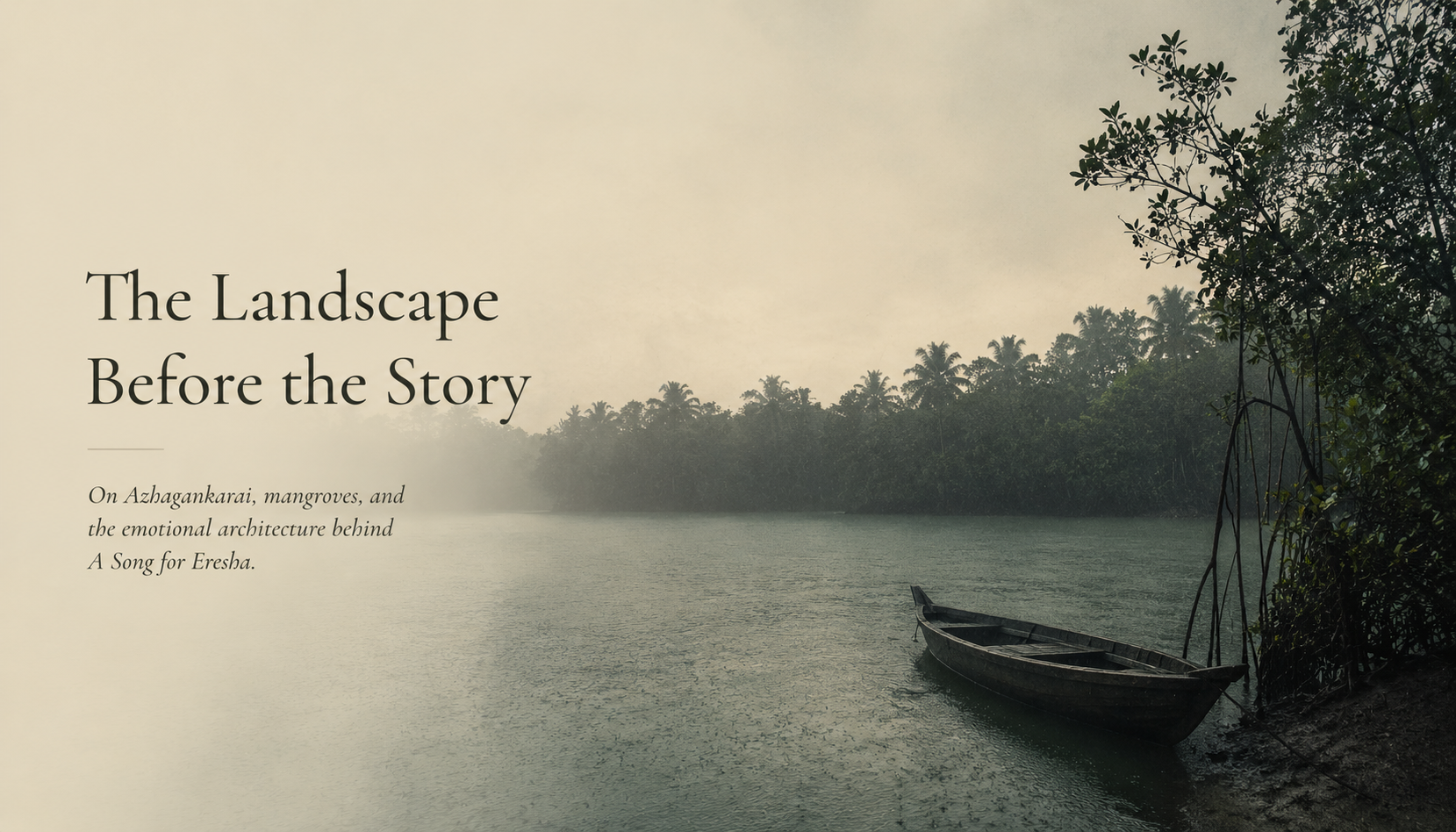
Long before A Song for Eresha became either a novel or a film, I found myself returning repeatedly to the marshlands and mangrove regions around Muthupet in Tamil Nadu. Not in any documentary sense, and not with the intention of reproducing the place directly, but because the terrain itself seemed to contain a certain emotional logic.
Mangroves are unusual environments. They feel open and enclosed at the same time. Water constantly shifts boundaries. Paths appear provisional. Sound travels strangely. Distance becomes difficult to measure. Even silence feels textured there. I was interested in what such a landscape does to perception.
Over time, this atmosphere slowly evolved into Azhagankarai, the fictional coastal town where A Song for Eresha is set. The town itself is imagined, but many of its rhythms emerged from those landscapes: the stillness of backwaters after rain, the isolation created by marshland, the sense that life unfolds slightly apart from ordinary time. At the centre of the story is Aalayam, a residential institution devoted to classical arts.
What interested me about institutions like these was not performance itself, but the structures surrounding it. Repetition. Hierarchy. Ritual. Admiration. The ways in which artistic spaces begin shaping the emotional behaviour of the people inside them. Over time, environments like these stop functioning merely as locations. They begin organising relationships. A corridor changes depending on who walks through it. Rehearsal halls acquire memory. Conversations carry further than intended. Silence develops social meaning. People begin performing versions of themselves even outside the work they create. The creative process within artistic institutions is often romanticised. Discipline. Devotion. Tradition. But spaces built around beauty can also become systems of control, sometimes so gently that nobody notices when it begins. That tension became central while writing the novel.
The landscape and the institution gradually began informing each other. The stillness of the mangroves entered the pacing of the story. The enclosed nature of the academy reflected the emotional containment of its characters. Even the production staged within the narrative eventually began feeling inseparable from the environment surrounding it.
In writing fiction, setting is often treated as backdrop. I became increasingly interested in treating place differently, not as scenery, but as an active emotional force within the narrative itself. Something that shapes behaviour quietly, persistently, almost invisibly. By the end of the process, Azhagankarai no longer felt like a fictional setting constructed for the story.
It felt like the story had emerged from the place itself.
Also Published on Medium.